How to Convert a Decimal to a Percent
The word percent literally means "per hundred" (from Latin per centum). When you have a regular decimal number where 1.0 represents one whole (100%), turning that decimal into a percentage is as straightforward as multiplying by 100.
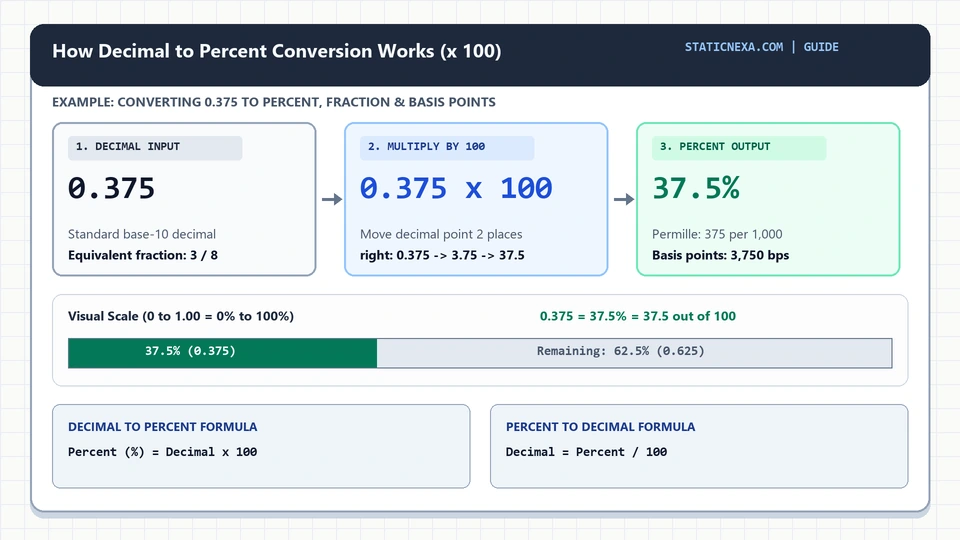
In everyday mental math, multiplying by 100 does the exact same thing as moving the decimal point two places to the right and attaching a % sign. Our calculator also goes further by showing the simplified fraction, per-thousand value (permille ‰), and basis points (bps), plus built-in tabs to convert percentages or fractions back the other way.
Decimal to Percent Formulas
Percent to Decimal: Decimal = Percent ÷ 100
Fraction to Percent: Percent (%) = (Numerator ÷ Denominator) × 100
Permille (per 1,000): Permille (‰) = Decimal × 1,000
Basis Points (bps): Basis Points = Decimal × 10,000
2 Worked Examples
Example 1: Standard Decimal Less Than 1 (0.375)
Suppose a batting statistic, survey share, or probability reads 0.375. Convert it to a percentage and simplified fraction:
- Multiply by 100:
0.375 × 100 = 37.5. - Attach the percent sign: 37.5%. (Shifting the decimal point two places right turns
0.375into37.5.) - Check the fraction form:
0.375 = 375/1000, which simplifies by dividing top and bottom by 125 to 3/8.
Example 2: Values Greater Than 1 and Very Small Rates (1.25 and 0.0045)
People often slip up when a decimal is either larger than 1 or starts with several zeros:
- Greater than 1 (
1.25): Multiply by 100 to get1.25 × 100 = 125%(which represents a whole100%plus an extra25%, the same multiplier used in our Percentage Increase Calculator). - Very small decimal (
0.0045): Shift two places right to get0.45%(less than 1%, not 4.5%). In finance and bond yields,0.0045equals45 basis points(0.0045 × 10,000 = 45 bps).
Quick Decimal, Fraction & Percent Chart
| Decimal | Percentage | Fraction | Basis Points (bps) |
|---|---|---|---|
| 0.01 | 1% | 1/100 | 100 bps |
| 0.05 | 5% | 1/20 | 500 bps |
| 0.1 | 10% | 1/10 | 1,000 bps |
| 0.125 | 12.5% | 1/8 | 1,250 bps |
| 0.25 | 25% | 1/4 | 2,500 bps |
| 0.3333… | 33.33% | 1/3 | 3,333.33 bps |
| 0.375 | 37.5% | 3/8 | 3,750 bps |
| 0.5 | 50% | 1/2 | 5,000 bps |
| 0.75 | 75% | 3/4 | 7,500 bps |
| 1.0 | 100% | 1/1 | 10,000 bps |
| 1.25 | 125% | 5/4 | 12,500 bps |
0.375 and clicking the % format button automatically displays 37.5% because spreadsheets store percentages as decimals underneath. If you already multiplied by 100 in a formula (=A2*100) and then click %, Excel will show 3,750%! Either format the decimal cell directly as %, or keep =A2*100 formatted as a plain number.
Want to put percentage decimals to work on real changes, shopping discounts, or lab measurements? Try our Percentage Change Calculator, Percent Off Calculator, or browse all tools on the Math Calculators hub. You can also review our rounding rules in the Editorial & Mathematical Accuracy Policy.
Frequently Asked Questions
How do you convert a decimal to a percent without a calculator?
Multiply the decimal by 100, which is equivalent to moving the decimal point two places to the right, and add a percent sign (%). Add trailing zeros if needed (for example, 0.4 becomes 40%).
What is 0.05 as a percentage?
0.05 equals 5% (0.05 x 100 = 5%). A very common mistake is reading 0.05 as 50%, which is actually 0.50.
Can a decimal greater than 1 be turned into a percent?
Yes. Any decimal above 1 converts to a percentage greater than 100%. For example, 1.25 equals 125% and 2.5 equals 250%.
How do I convert a percentage back into a decimal?
Divide the percentage by 100, or move the decimal point two places to the left and drop the % sign. For example, 37.5% becomes 0.375.
What are basis points (bps) and permille?
Permille (‰) means per thousand (Decimal x 1,000), and one basis point (bps) equals one-hundredth of 1% (Decimal x 10,000). They are widely used in finance and interest-rate reporting to describe small percentage differences.
Mathematical References & Standards
- OpenStax Prealgebra (2e): Section 6.1: Understand Percent (Decimals, Fractions, and Percents) (Open textbook explanations for converting between decimals, fractions, and percents)
- Khan Academy: Converting Between Percents, Fractions, and Decimals (Step-by-step exercises and decimal-shift rules)
- Wikipedia: Percentage: Definition, Notation & Conversions (History, per-centum definition, and mathematical notation)
- Wikipedia: Basis Point & Permille Conventions (Reference on financial basis points (1/100th of a percent) and permille)