What Is Percentage Difference and When Should You Use It?
Percentage difference measures the relative distance between two peer numbers without favoring either value as the starting point or accepted truth. Whenever you have two independent price quotes, two product weights, two competing test scores, or two laboratory trials collected on equal footing, percentage difference gives you a single symmetric answer that never changes if you swap Value A and Value B.
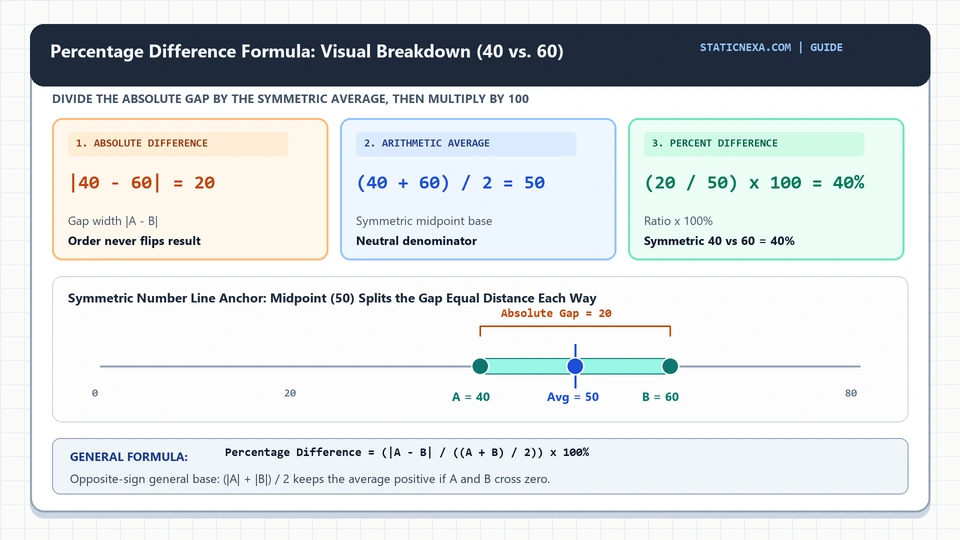
That symmetry is what separates percentage difference from percentage change and percent error. Suppose Vendor A quotes you $40 and Vendor B quotes you $60. Neither price came "before" the other, and neither price is an official textbook answer. Instead of anchoring the denominator to $40 (+50% higher) or to $60 (-33.33% lower), percentage difference divides the $20 gap by the exact midpoint average ($50), reporting an unambiguous 40% difference regardless of which quote you examine first.
Percentage Difference Formula
To calculate the percentage difference between two numbers A and B, divide the absolute difference between them by their arithmetic average, then multiply by 100:
Opposite-Sign General Form: Percentage Difference = (|A − B| ÷ ((|A| + |B|) ÷ 2)) × 100%
Solve Partner Bounds (0 ≤ D < 200%): B_high = A × (200 + D) ÷ (200 − D) | B_low = A × (200 − D) ÷ (200 + D)
- Numerator
|A − B|(Absolute Difference): The vertical bars represent absolute value, so subtracting40 − 60 = −20turns positive into20. Because distance is always non-negative, percentage difference is always zero or positive. - Denominator
(A + B) ÷ 2(Symmetric Average): Using the arithmetic midpoint treats both values identically. In chemistry, environmental monitoring, and engineering, this exact quantity is commonly called Relative Percent Difference (RPD). - Opposite-Sign Handling: If
AandBsit on opposite sides of zero (such as−20and+60, or−50and+50), plain(A + B) ÷ 2shrinks toward zero or vanishes completely at0. Using the average of absolute magnitudes(|A| + |B|) ÷ 2keeps the symmetric base positive and prevents division-by-zero blowups whenever at least one number is nonzero.
2 Worked Examples
Example 1: Comparing Two Contractor Quotes ($400 vs. $600)
Imagine you request estimates from two independent contractors for the same repair job. Contractor A quotes $400 and Contractor B quotes $600. Because neither quote is an "old" baseline, you want the neutral percentage difference between the two bids:
- Compute the absolute gap: Subtract the two prices and drop any negative sign:
|400 − 600| = 200. - Find the average price: Add both quotes and divide by two:
(400 + 600) ÷ 2 = 500. - Divide and scale to 100: Divide the gap by the average:
200 ÷ 500 = 0.40, then multiply by 100 to get 40%.
Notice how misleading directional math would look here: saying "$600 is 50% more than $400" while "$400 is 33.33% less than $600" describes the exact same pair of bids with two conflicting numbers! Percentage difference resolves that conflict by evaluating both quotes around their $500 midpoint, yielding 40% either way. You can verify both figures together by switching our tool above into Diff vs. Change mode.
Example 2: Independent Lab Sensors (9.65 vs. 9.95) Plus Finding Allowed Bounds
In a physics experiment or water-quality audit, two sensors measure the same sample simultaneously. Sensor 1 reads 9.65 and Sensor 2 reads 9.95. Neither sensor is certified as an absolute standard yet, so the lab reports their Relative Percent Difference (RPD):
- Absolute difference:
|9.65 − 9.95| = 0.30. - Average measurement:
(9.65 + 9.95) ÷ 2 = 19.60 ÷ 2 = 9.80. - Percentage difference:
(0.30 ÷ 9.80) × 100 ≈ 3.0612%.
Now consider the reverse quality-control question supported by the Find Matching Value tab: suppose Sensor A records 100 and your lab protocol rejects duplicate pairs whose percentage difference reaches 40% or higher. What exact upper and lower readings sit right at a 40% difference from 100?
- Upper threshold:
100 × (200 + 40) ÷ (200 − 40) = 100 × (240 ÷ 160) = 150. Check:|100 − 150| ÷ 125 × 100 = 40%. - Lower threshold:
100 × (200 − 40) ÷ (200 + 40) = 100 × (160 ÷ 240) ≈ 66.6667. Check:|100 − 66.6667| ÷ 83.3333 × 100 = 40%.
Notice that the upper bound sits +50 above 100, while the lower bound sits only 33.3333 below 100. Why? Because moving upward raises the average denominator (125), whereas moving downward shrinks the average denominator (83.3333). Using the exact algebraic solver prevents the common error of testing 100 ± 40% (60 and 140), which would actually produce 50% difference at 60 and 33.33% difference at 140.
Percentage Difference vs. Percentage Change vs. Percent Error
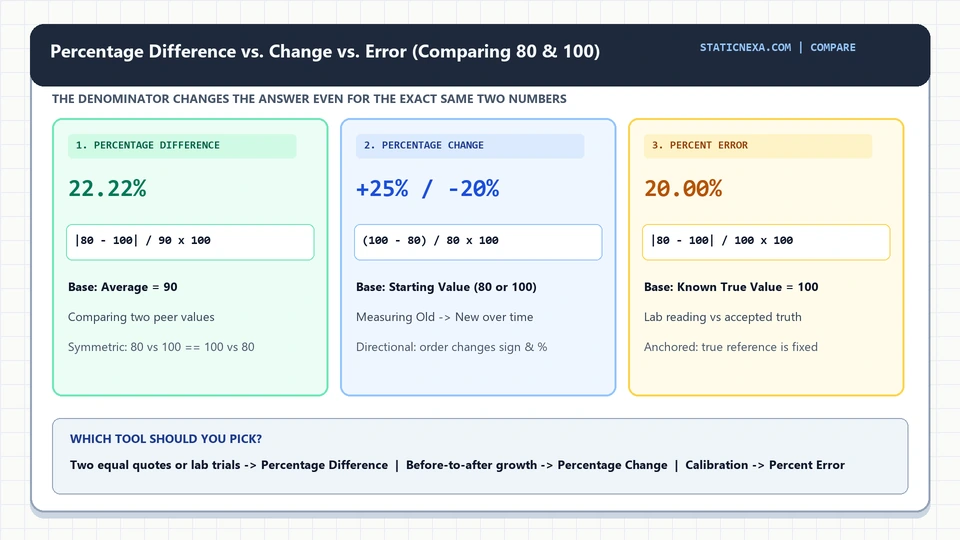
Choosing the wrong denominator is the single most common error when reporting comparative data. Even using the exact same two numbers (80 and 100), three completely legitimate calculations return three distinct percentages because they answer three different questions:
| Metric | Formula | 80 vs. 100 Result | Order Matters? | When to Use It |
|---|---|---|---|---|
| Percentage Difference | (|A − B| ÷ ((A + B) ÷ 2)) × 100 | 22.22% | No (symmetric) | Comparing two equal peers, quotes, or duplicate lab tests |
| Percentage Change | ((New − Old) ÷ |Old|) × 100 | +25% or −20% | Yes (directional) | Tracking growth or decline from an earlier value to a newer value |
| Percent Error | (|Measured − True| ÷ |True|) × 100 | 20.00% (if True=100) | Yes (anchored) | Checking instrument accuracy against a known accepted standard |
| Percentage Points | P₂ − P₁ | +20 pp (80% to 100%) | Yes (signed) | Subtracting two values that are already expressed as percentages |
Symmetry Properties & Why Positive Percentage Difference Caps at 200%
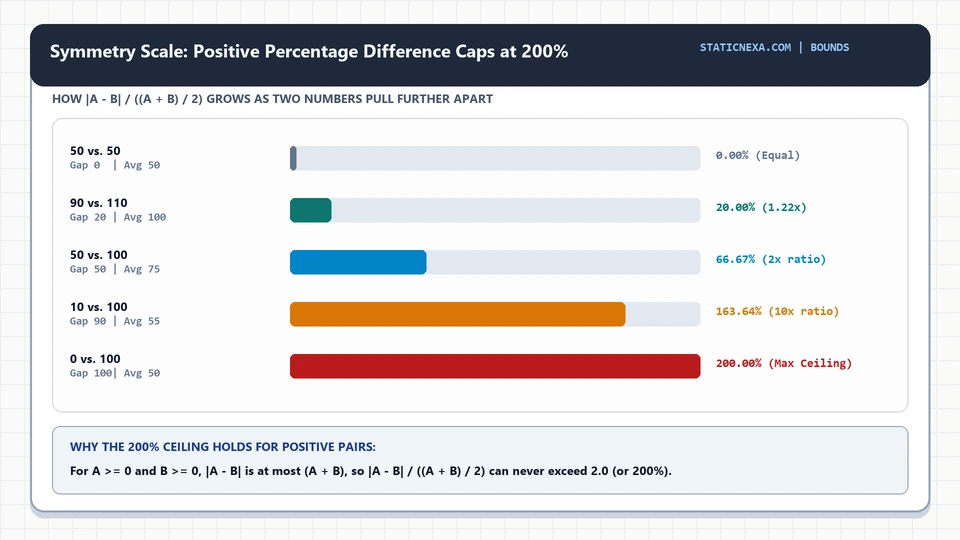
Many users feel surprised when a huge gap between two positive numbers approaches 200% and stops dead right there instead of growing to 500% or 1,000% like percentage increase can. Understanding why reveals a neat algebraic boundary:
Whenever both values are non-negative (A ≥ 0 and B ≥ 0, not both zero), the gap |A − B| can never be larger than their sum A + B. Because the denominator is half that sum ((A + B) ÷ 2), the ratio |A − B| ÷ ((A + B) ÷ 2) rewrites as 2 × |A − B| ÷ (A + B). Since |A − B| ≤ A + B, that ratio is strictly trapped between 0 and 2, which equals 0% to 200% after multiplying by 100!
| Number Pair (A vs. B) | Absolute Gap |A − B| | Average (A + B) ÷ 2 | Ratio (B ÷ A) | Percentage Difference |
|---|---|---|---|---|
| 50 vs. 50 | 0 | 50 | 1.00× | 0.00% |
| 95 vs. 105 | 10 | 100 | 1.11× | 10.00% |
| 80 vs. 100 | 20 | 90 | 1.25× | 22.22% |
| 40 vs. 60 | 20 | 50 | 1.50× | 40.00% |
| 50 vs. 100 | 50 | 75 | 2.00× | 66.67% |
| 10 vs. 100 | 90 | 55 | 10.00× | 163.64% |
| 0 vs. 100 | 100 | 50 | N/A | 200.00% (Max) |
Wait a moment: what happens if one value is negative and the other is positive, such as −20 and +60? Under our opposite-sign general denominator (|A| + |B|) ÷ 2, the absolute gap is |−20 − 60| = 80 and the average magnitude is (20 + 60) ÷ 2 = 40, giving (80 ÷ 40) × 100 = 200%. In fact, any opposite-sign pair evaluated with (|A| + |B|) ÷ 2 produces exactly 200% because moving from a negative number across zero to a positive number spans the entire sum of their distances from zero!
Practical Applications Across Industries
Percentage difference appears across science, procurement, pricing analysis, and engineering because real-world analysts frequently evaluate pairs where neither option owns priority over the other:
- Analytical Chemistry & Environmental Testing (RPD): Laboratories run duplicate analyses on split water or soil samples. Because both aliquots come from the same batch, quality assurance manuals measure repeatability with Relative Percent Difference (RPD), often requiring duplicate pairs to stay below 10% or 20% difference.
- Procurement & Vendor Bid Comparison: When evaluating two shipping carriers, SaaS plans, or contractor quotes side by side, percentage difference tells stakeholders how far apart the bids are relative to the average market mid-price.
- Real Estate Comps & Appraisals: Comparing two recently sold homes in the same neighborhood (
$420,000vs.$460,000equals9.09%difference) avoids exaggerating the gap from the perspective of only the cheaper or costlier home. - A/B Split Tests & Model Benchmarks: When comparing two newly launched algorithms, manufacturing lines, or latency runs against each other rather than against an older legacy system, symmetric percentage difference prevents bias toward whichever algorithm happens to sit in Column A.
- Financial Ratios & Midpoint Elasticity: Economists use the exact same midpoint denominator (
|Q₂ − Q₁| ÷ ((Q₁ + Q₂) ÷ 2)) in the Arc Elasticity of Demand formula so price elasticity stays consistent whether prices move up or down along a demand curve.
Percentage Difference Formulas in Excel & Google Sheets
If you audit large datasets in Excel, Google Sheets, or LibreOffice Calc, place your two values in columns A and B and enter any of these spreadsheet formulas:
Return Plain Number (e.g. 40 instead of 40%): =(ABS(A2-B2)/AVERAGE(A2,B2))*100
Zero-Safe Formula (handles 0 and 0 cleanly): =IF(AND(A2=0,B2=0),"Undefined",ABS(A2-B2)/AVERAGE(ABS(A2),ABS(B2)))
Find Upper Match for Base A2 & Target Diff C2 (%): =A2*(2+C2)/(2-C2)
5 Common Mistakes When Calculating Percentage Difference
- Dividing by One Value Instead of the Average: Dividing
|A − B|byAorBcalculates directional percentage change or percent error, not percentage difference. Always verify that both values were summed and halved in the denominator. - Forgetting the Absolute Value Bars: Leaving out
|A − B|produces a negative percentage whenA < B, breaking symmetry betweendiff(A, B)anddiff(B, A). Percentage difference is always non-negative. - Testing Tolerance With Simple ±D%: Checking whether two quotes differ by at most 20% by multiplying
100 ± 20%(giving80and120) creates asymmetric percentage differences (22.22%on the low end and18.18%on the high end). Use the exact reverse bounds formula (81.82and122.22) in Mode 3 instead. - Using Percentage Difference for Stock Returns or Revenue Growth: Time-series growth always moves from an earlier starting period to a later period. If order in time matters, switch to our Percentage Change Calculator so gains and losses preserve their
+and−signs. - Averaging Two Percentage Values Directly: Even if your numbers represent percentages (say
10%and12%), decide first whether your report expects 2 percentage points (Percentage Point Calculator) or a relative midpoint spread (18.18%). Mixing units confuses readers immediately.
Related Math & Percentage Calculators
Need another perspective on the same numbers? Explore our companion tools across the Math Calculators hub:
- Percentage Change Calculator: directional percent increase or decrease from a starting value to a final value.
- Percent Error Calculator: compare an observed laboratory measurement against an accepted true value.
- All-in-One Percentage Calculator: solve
X% of Y,X is what % of Y, change %, and reverse whole values in four live rows. - Percentage Point Calculator: arithmetic difference in percentage points (pp) and basis points (bps).
Every edge case, opposite-sign rule, and precision boundary is verified under our Editorial & Mathematical Accuracy Policy.
Frequently Asked Questions
What is the formula for percentage difference between two numbers?
Percentage Difference = (|A - B| / ((A + B) / 2)) x 100. You take the absolute difference between the two numbers, divide by their arithmetic average, and multiply by 100.
How is percentage difference different from percentage change?
Percentage difference is symmetric and divides by the average of both numbers, so swapping A and B never changes the answer. Percentage change is directional (Old to New) and divides by the starting value, so 80 to 100 is +25% while 100 to 80 is -20% (compared with a 22.22% percentage difference).
Why does positive percentage difference never exceed 200%?
For any two non-negative numbers A and B, their difference |A - B| can never exceed their sum (A + B). Dividing |A - B| by half that sum ((A + B) / 2) yields a ratio of at most 2.0, which equals 200%.
Can percentage difference ever be negative?
No. Because the numerator uses the absolute difference |A - B| and the symmetric denominator uses positive magnitude, percentage difference is always 0% or positive. If you need a signed gain or drop over time, use Percentage Change instead.
What happens if both numbers are zero?
If A = 0 and B = 0, both the difference (0) and the average (0) equal zero, resulting in 0 / 0, which is mathematically undefined.
What is Relative Percent Difference (RPD) in chemistry and engineering labs?
Relative Percent Difference (RPD) is the laboratory and environmental testing name for Percentage Difference. It compares two duplicate experimental trials where neither measurement is treated as an absolute standard.
Mathematical References & Standards
- Wikipedia: Relative Change and Difference (Percentage Difference Formula) (Mathematical distinction between symmetric relative difference and directional relative change)
- Wikipedia: Percentage: Arithmetic Properties & Comparisons (Foundational notation, ratios, and symmetric vs. asymmetric percent comparisons)
- OpenStax Prealgebra (2e): Section 6.2: Solve General Applications of Percent (Open textbook foundation on percent equations, difference applications, and percent change)
- Khan Academy: Percentages: Rates, Ratios, and Comparative Problems (Interactive practice and worked arithmetic explanations for percentage comparisons)