How Percentage Decrease Works in Everyday Math
Whether you are checking how much a monthly expense dropped, figuring out the checkout price during a 30%-off sale, or working backward from a clearance tag to see what the item originally cost, percentage decrease always comes down to one idea: tracking the remaining share.
Instead of calculating a discount and subtracting it in two separate steps, thinking in terms of what stays behind, (1 − P ÷ 100), lets you solve forward and reverse problems cleanly. Use the mode tabs at the top of this calculator to switch between all three workflows. If your numbers moved upward instead, jump to our Percentage Increase Calculator, use the Percentage Change Calculator for mixed positive/negative swings, or explore the full Math Calculators hub.
The Three Percentage Decrease Formulas
2) Subtract P% (Discount): Final = Original × (1 − P ÷ 100)
3) Reverse Original Price: Original = Final ÷ (1 − P ÷ 100)
For example, a 25% discount removes 25% and leaves 75% behind (1 − 0.25 = 0.75). Multiplying any price by 0.75 gives the sale price immediately, and dividing a sale price by 0.75 restores the full sticker price.
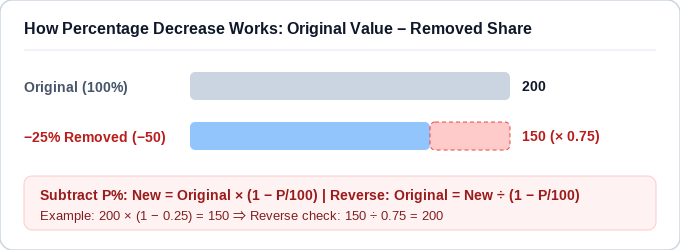
Discount & Reduction Quick Reference Table
Keep these remaining-share multipliers handy when comparing markdowns, budget cuts, or annual reductions:
| Decrease (%) | Remaining Multiplier (1 − P/100) | Example on 200 | Reverse Check (Final ÷ Multiplier) |
|---|---|---|---|
| −5% | × 0.95 | 190 | 190 ÷ 0.95 = 200 |
| −10% | × 0.90 | 180 | 180 ÷ 0.90 = 200 |
| −15% | × 0.85 | 170 | 170 ÷ 0.85 = 200 |
| −20% | × 0.80 | 160 | 160 ÷ 0.80 = 200 |
| −25% | × 0.75 | 150 | 150 ÷ 0.75 = 200 |
| −50% | × 0.50 | 100 | 100 ÷ 0.50 = 200 |
| −75% | × 0.25 | 50 | 50 ÷ 0.25 = 200 |
4 Discount & Reduction Traps People Fall Into
1. Stacked Discounts ("20% Off + Extra 10% Off" Is Not 30% Off)
0.80, then by 0.90: 0.80 × 0.90 = 0.72. You pay 72% of the original price, which is a 28% total decrease (not 30%). See chain discounts in retail pricing for more examples.
2. Never Add the Same Percentage Back to Undo a Discount
Suppose a jacket costs $150 after a 25% discount. Many people mistakenly add 25% of $150 ($37.50) to estimate the original price, getting $187.50. That falls short because 25% of $187.50 is $46.88, not $37.50. The accurate pre-discount calculation divides by (1 − 0.25) = 0.75: 150 ÷ 0.75 = $200.
3. Can a Percentage Decrease Exceed 100%?
For things that cannot fall below zero, like retail prices, body weight, or battery charge, 100% is the steepest possible drop (taking the value to 0). However, for quantities that can turn negative, such as net profit, cash flow, or Celsius temperatures, a drop can exceed 100%. Moving from +100 down to −20 is a 120% decrease. In accounting and asset tracking, multi-year percentage drops on a shrinking base are commonly modeled as declining-balance depreciation.
4. Zero Starting Values & Accidental Increases
Just like percentage change, percentage decrease cannot start from 0 because the formula divides by |Original|. And if you enter a higher "New Value" in Find % Decrease mode (say, 150 → 200), the calculator warns you that the value actually increased rather than silently flipping the sign. Review our calculation conventions on our Editorial & Mathematical Accuracy Policy page.
Excel & Google Sheets Formulas
To run any of these three percentage decrease calculations in Excel or Google Sheets (using decimal or percent-formatted P):
Subtract P% (Discount): =Original * (1 - P)
Pre-Discount Original: =Final / (1 - P)
Frequently Asked Questions
How do I calculate a 25% discount in one step?
Subtract the discount percentage from 100% to get the remaining share (100% - 25% = 75%, or 0.75), then multiply the original price by 0.75. For example, 200 x 0.75 = 150.
How do I find the original price before a percentage discount?
Divide the sale price by (1 - P/100). For example, if an item costs 150 after a 25% discount, divide 150 by 0.75 to get the original price of 200.
Why is 20% off plus an extra 10% off equal to 28% off instead of 30%?
The extra 10% discount applies to the already-reduced 80% price, not the full original price. Multiplying 0.80 x 0.90 gives 0.72 (72% remaining), which is a 28% total reduction.
Can a positive value decrease by more than 100%?
Yes, if the final value drops below zero (for example, dropping from +100 to -20 is a 120% decrease). For retail prices or physical amounts that stop at zero, 100% is the maximum possible decrease.
How do I calculate percentage decrease in Excel?
Use =(Original-New)/ABS(Original) formatted as a Percentage to measure a drop, or =Original*(1-DiscountPercent) to calculate a discounted price.
Mathematical References & Standards
- OpenStax Prealgebra (2e): Section 6.3: Solve Sales Tax, Commission, and Discount Applications (Open textbook examples for discount amounts, sale prices, and percent equations)
- Khan Academy: Percentage Change Review & Percent Decrease Word Problems (Worked practice problems on percentage decrease and markdowns)
- Wikipedia: Discounts and Allowances: Chain & Trade Discounts (Reference on stacked/chain discounts and commercial markdown pricing)
- Wikipedia: Depreciation: Declining-Balance Percentage Reductions (Standard accounting methods for repeated percentage value reductions)