What Percent Error Measures (and Why It Matters)
Suppose your kitchen scale reads 2 grams off. Is that good enough? If you are weighing a 2,000-gram bag of flour, 2 grams is a tiny 0.1% error. If you are weighing a 4-gram chemical sample, 2 grams is a massive 50% error that can ruin an experiment.
Percent error compares how far your measured or estimated value landed from a known true (accepted) value, scaled as a percentage of that true value. Students use it in chemistry and physics lab reports, engineers use it to check sensor calibration, and forecasters use it to test how well predictions match actual results.
Percent Error Formulas (Unsigned vs. Signed)
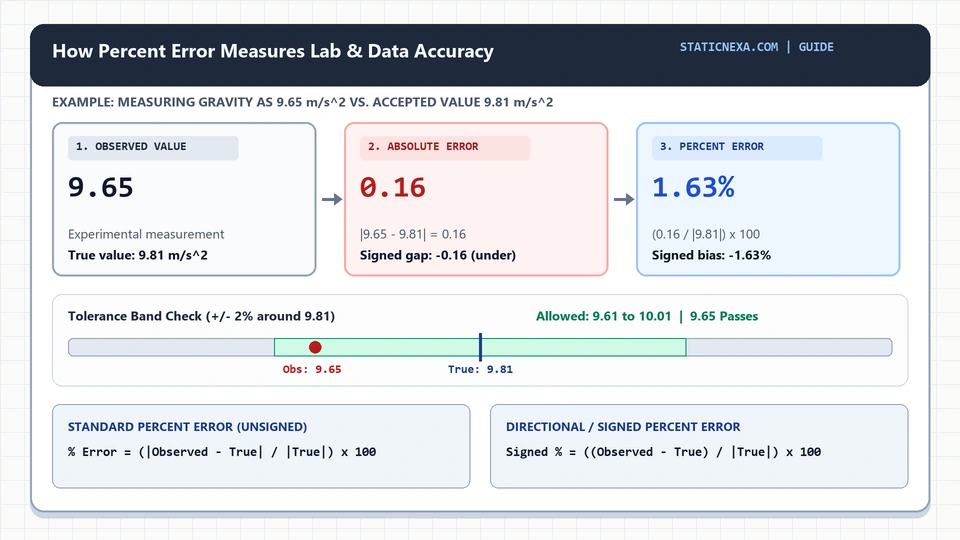
Percent Error (Standard): % Error = (|Observed − True| ÷ |True|) × 100
Signed Relative Error: Signed % = ((Observed − True) ÷ |True|) × 100
Tolerance Range (±P%): Bounds = True ± (|True| × P ÷ 100)
Most school and lab rubrics ask for the unsigned percent error (always zero or positive) because they only care about how close you got. In engineering, manufacturing, and forecasting, however, keeping the plus or minus sign matters just as much because it tells you whether readings consistently drift high (overestimate) or low (underestimate). Our calculator shows both side by side.
2 Worked Examples
Example 1: Physics Lab Measurement (Acceleration Due to Gravity)
A student uses a pendulum timer in lab and measures acceleration due to gravity as 9.65 m/s². The accepted textbook value is 9.81 m/s².
- Find the absolute error:
|9.65 − 9.81| = |-0.16| = 0.16 m/s². - Divide by the accepted value:
0.16 ÷ 9.81 ≈ 0.01631. - Multiply by 100:
0.01631 × 100 = 1.631%error (or−1.631%signed, meaning the reading underestimated gravity slightly).
Example 2: Chemistry Density Lab + Tolerance Check
A lab group measures the density of a copper block as 8.70 g/cm³, while the accepted reference density of pure copper is 8.96 g/cm³, and the instructor allows up to ±5% experimental error.
- Absolute error:
|8.70 − 8.96| = 0.26 g/cm³. - Percent error:
(0.26 ÷ 8.96) × 100 ≈ 2.902%(signed bias:−2.902%). - Tolerance check (±5%):
8.96 × 0.05 = ±0.448, so the passing range is8.512 to 9.408 g/cm³. Since8.70falls inside that range (and2.902% < 5%), the measurement passes.
Percent Error vs. Percentage Change vs. Percent Difference
These three formulas look almost identical, which is why mixing up the denominator is one of the easiest mistakes in math and science. Use this table to pick the right tool:
| Metric | Denominator | When to Use It | Tool |
|---|---|---|---|
| Percent Error | |True Value| | Comparing an experiment or estimate against a known accepted truth. | This calculator |
| Percentage Change | |Initial Value| | Measuring how one value shifted over time from old to new. | Percentage Change |
| Percentage Increase / Decrease | |Original Value| | Adding tax/markups or calculating retail discounts and drops. | Increase / Percent Off |
| Percent Difference | (A + B) ÷ 2 | Comparing two equal measurements when neither one is the "true" answer. | Math Hub |
Important Edge Cases & Excel Formula
0 (for example, 0°C freezing point), percent error is mathematically undefined because you cannot divide by 0. When your true value is 0, report the Absolute Error (|Observed − 0|) in physical units instead, or convert to an absolute scale such as Kelvin. See our Editorial & Mathematical Accuracy Policy for more edge-case standards.
To calculate percent error inside Excel or Google Sheets (with Observed in A2 and True Value in B2), format cell C2 as Percent (%) and enter:
Signed % Error: =(A2-B2)/ABS(B2)
Frequently Asked Questions
Can percent error be negative?
Standard percent error uses absolute value bars in the numerator |Observed - True|, so it is always 0% or positive. Signed relative error omits the outer absolute value bars so negative percentages show an underestimate and positive percentages show an overestimate.
What is a good or acceptable percent error in a lab?
It depends on the experiment and equipment. High school chemistry and physics labs often accept under 5% error, while analytical chemistry or calibrated engineering sensors may require under 1% or 0.1%.
What is the difference between percent error and percent difference?
Percent error compares a measurement against a known accepted true value, dividing by |True|. Percent difference compares two measurements when neither is known to be exact, dividing |A - B| by their average (A + B) / 2.
Why does percent error say undefined when the true value is 0?
Percent error divides by |True|. When the true value equals 0, division by zero is undefined, so scientists report absolute error in original units instead.
How do you calculate percent error in Excel or Google Sheets?
Use =ABS(Observed-True)/ABS(True) formatted as a Percentage for standard unsigned percent error, or =(Observed-True)/ABS(True) to keep the sign.
Mathematical References & Standards
- OpenStax Chemistry (2e): Section 1.5: Measurement Uncertainty, Accuracy, and Precision (Open textbook reference on experimental accuracy, precision, and error)
- Wikipedia: Approximation Error: Absolute and Relative Error (Formal mathematical definitions of absolute error, relative error, and percent error)
- Wikipedia: Mean Absolute Percentage Error (MAPE) (Statistical applications of percentage error and zero-denominator caveats)
- NIST / SEMATECH: e-Handbook of Statistical Methods (Measurement uncertainty and statistical error evaluation standards)