What a Grade Percentage Calculator Does and When You Need Each Mode
Grading looks simple on a single quiz, where you just divide the points you got right by the total points on the page. Once you move into a full high school or college semester, however, instructors rarely score everything on one flat point scale. One syllabus puts 20% on homework, 15% on weekly quizzes, 30% on a midterm, and 35% on a cumulative final. Another class counts total points across dozens of labs and lets you add extra credit on top. And right before finals week, almost every student asks the exact same practical question: what score do I need on the final exam to keep an A or pass the course?
This Grade Percentage Calculator brings all three of those everyday academic calculations together in one place. Use Test / Quiz Score to grade a single exam, worksheet, or rubric (with optional bonus points), switch to Weighted Course Grade to add as many syllabus categories as you want and see your live course standing, or open Final Exam Target to solve for the exact exam score required to hit your target letter grade. As you type, the Math Notebook panel prints the exact arithmetic line by line alongside a live U.S. A-to-F scale marker so you can double-check every step.
All Grade Percentage Formulas Explained
Every grade calculation relies on one of four core equations depending on how your teacher or professor weights coursework:
With Extra Credit: Grade % = ((Points Earned + Bonus Points) ÷ Total Possible Points) × 100
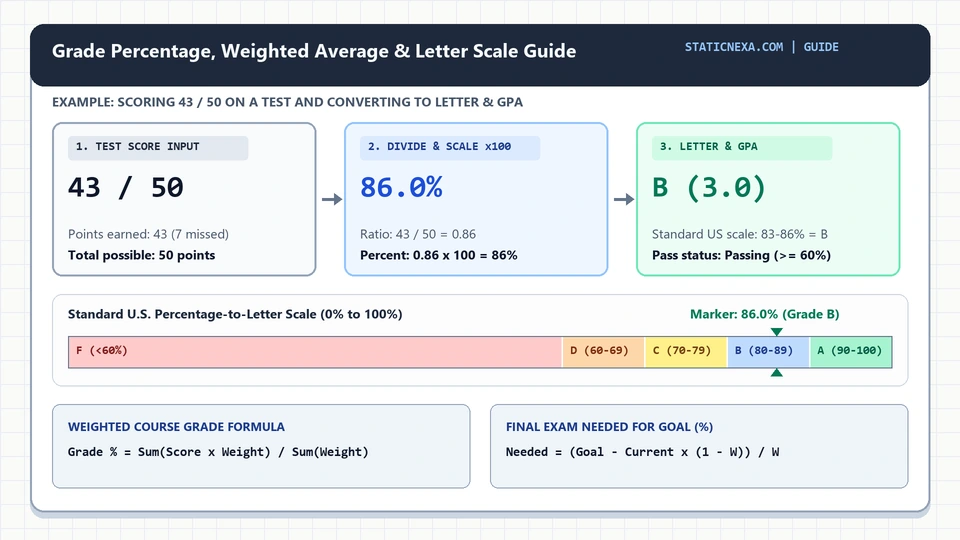
Weighted Course Average: Course % = Σ(Category Score × Category Weight) ÷ Σ(Category Weights)
Final Exam Needed: Needed % = (Target Grade − Current Grade × (1 − W)) ÷ W [where W = Exam Weight ÷ 100]
- Single Assignment / Test Formula: Divides what you earned by the maximum possible score and multiplies by 100 to turn the decimal ratio into a percentage. If you got 43 out of 50 right,
43 ÷ 50 = 0.86, which becomes86%. - Extra Credit Formula: Adds bonus points directly to the numerator while keeping the original denominator unchanged. That is why extra credit can push an assignment or course percentage above 100%.
- Weighted Course Average Formula: Multiplies each assignment or category percentage by its syllabus weight, adds those products together, and divides by the sum of all completed weights. Dividing by
Σ(Weights)rather than always dividing by 100 is essential mid-semester when not every exam has been graded yet. - Final Exam Target Formula: Treats your current average as locking in
(1 − W)of your final grade, subtracts those locked-in points from your goal, and divides the remaining gap by the final exam weightW.
2 Worked Examples
Example 1: Single Test Score With and Without Extra Credit (43 Out of 50)
Imagine you take a 50-point biology quiz and miss 7 points, earning 43 points. Your teacher also offered a 3-point bonus question at the end of the quiz. Let us calculate your grade both ways:
- Base percentage without bonus: Divide points earned by total possible points:
43 ÷ 50 = 0.86. Multiply by 100 to get 86.0%. On the standard U.S. plus/minus grading scale,86.0%is a solid B (worth 3.0 GPA points) and a passing score. - With 3 extra credit points: Add the 3 bonus points to your numerator while leaving the 50-point denominator as-is:
(43 + 3) ÷ 50 = 46 ÷ 50 = 0.92. Multiplying by 100 raises your grade to 92.0%, moving you from a B all the way up to an A- (3.7 GPA points). - Checking the points missed: Notice that each point on a 50-point quiz is worth
100 ÷ 50 = 2%of the quiz grade. Missing 7 points costs7 × 2% = 14%, which matches100% − 86% = 14%.
Example 2: Weighted Course Grade and Final Exam Target
Now suppose your history class uses weighted categories on the syllabus: Homework (20%), Quizzes (15%), Midterm Exam (30%), and Final Exam (35%). Before finals week, your scores are 92% in Homework, 88% in Quizzes, and 84% on the Midterm.
Part A (Your standing before the final): So far, 20% + 15% + 30% = 65% of the course has been graded. Multiply each completed score by its weight and divide by 65:
Homework: 92 × 20 = 1,840(contributes18.40points toward 100)Quizzes: 88 × 15 = 1,320(contributes13.20points toward 100)Midterm: 84 × 30 = 2,520(contributes25.20points toward 100)- Current average:
(1,840 + 1,320 + 2,520) ÷ 65 = 5,680 ÷ 65 ≈ 87.38%(a B+).
Part B (What you need on the 35% Final Exam to finish with an A- / 90%): Your 87.38% current standing covers 65% (0.65) of the final course grade, giving 87.38 × 0.65 = 56.80 locked-in points. To reach 90.00 total points, you need 90.00 − 56.80 = 33.20 points from the 35% final: 33.20 ÷ 0.35 ≈ 94.86%. If you actually score 90% on the final, your complete weighted average becomes (5,680 + 90 × 35) ÷ 100 = 8,830 ÷ 100 = 88.30% (a B+).
Standard U.S. Letter Grade & 4.0 GPA Conversion Chart
Most American high schools, colleges, and universities use a 10-point percentage band system (with plus and minus modifiers) mapped onto a 4.0 Grade Point Average scale. Keep in mind that individual instructors or departments occasionally shift cutoffs slightly, such as requiring 94% instead of 93% for a flat A, or omitting A+ altogether (treating both A and A+ as 4.0). Always check your course syllabus when a border score like 89.5% or 92.8% is on the line.
| Letter Grade | Percentage Range | 4.0 GPA Value | Academic Standing |
|---|---|---|---|
| A+ | 97% – 100%+ | 4.0 | Highest honors / distinction |
| A | 93% – 96.99% | 4.0 | Excellent mastery |
| A- | 90% – 92.99% | 3.7 | Strong honors |
| B+ | 87% – 89.99% | 3.3 | Very good performance |
| B | 83% – 86.99% | 3.0 | Above average / solid competence |
| B- | 80% – 82.99% | 2.7 | Good standing |
| C+ | 77% – 79.99% | 2.3 | Satisfactory |
| C | 73% – 76.99% | 2.0 | Average / minimum for many majors |
| C- | 70% – 72.99% | 1.7 | Low passing (check prerequisite rules) |
| D+ | 67% – 69.99% | 1.3 | Marginal pass |
| D | 65% – 66.99% | 1.0 | Lowest standard pass |
| D- | 60% – 64.99% | 0.7 | Minimum passing in 60%-cutoff schools |
| F | Below 60% | 0.0 | Failing / no credit earned |
Total-Points Grading vs. Weighted-Category Grading
Students are often surprised when two courses with the exact same assignment scores produce different final percentages. The reason almost always comes down to whether the teacher uses a total-points gradebook or a weighted-category gradebook.
In a total-points system, every point is worth the same regardless of whether it came from a daily homework sheet or a midterm exam. If your total points across the term add up to 500, then a 100-point test automatically carries 20% weight (100 ÷ 500) and a 10-point quiz carries 2% weight (10 ÷ 500). To compute your grade in a total-points class, simply sum all points earned, sum all points possible, and enter those two totals into our Test / Quiz Score tab.
In a weighted-category system, the syllabus fixes each group's influence in advance. Even if your homework assignments add up to 800 points and your final exam is graded out of just 50 points, a 20% homework weight and 35% final exam weight mean each single point on that 50-point final exam impacts your course grade far more than a point of homework. That is why tracking weights separately in our Weighted Course Grade tab gives you a much truer picture of where your grade stands.
How Mid-Semester Partial Weights Work (Avoid This Common Mistake)
56.80 ÷ 0.65 = 87.38%, a B+). Our Weighted Course Grade calculator handles partial weights automatically and shows you how much syllabus weight remains ungraded.
Thinking in terms of "points earned out of points attempted so far" prevents unnecessary panic when checking an online gradebook like Canvas, Blackboard, or Google Classroom halfway through a term. Whenever an ungraded category says 0/0 or hasn't been entered yet, ignore its empty weight when evaluating your current pace, and focus on the ratio of weighted points earned to weighted percentage completed.
Extra Credit, Dropped Lowest Scores, and Grading Curves
Real classrooms frequently include special grading adjustments that affect percentages in subtle ways:
- Extra Credit on a Test vs. Extra Credit on the Course: Adding 5 bonus points onto a 100-point exam raises that single exam by 5%, which raises a 20%-weighted course category by
5% × 0.20 = 1%overall. By contrast, adding 2 percentage points directly onto your final course average is twice as powerful. - Dropping the Lowest Quiz or Lab: When a syllabus drops your lowest quiz out of 10, your category average jumps fastest if that lowest score was far below your mean (especially a missing
0%). You can check the before-and-after jump cleanly using our Percentage Point Calculator or Percentage Change Calculator. - Flat Curves vs. Square-Root Curves: A flat curve adds the same fixed number of percentage points to every student's score (for instance, raising the class average from 68% to 75% by adding +7 pp). A square-root curve uses
10 × √(Raw %), which lifts lower scores more strongly than scores already near 100% (turning a 64% into10 × 8 = 80%, while lifting a 90% to94.87%). - Knowing When a Target Grade Requires Over 100%: In our Final Exam Target mode, if the calculated exam score comes out above 100% (say,
104.5%), it means reaching that target grade is mathematically impossible from the final exam alone unless extra credit or a grade curve is available.
5 Common Grade Calculation Mistakes
- Averaging Percentages Instead of Points: Suppose you score
10/10(100%) on a tiny quiz and60/100(60%) on a major test in a total-points class. Averaging100%and60%gives80%, which is wrong! Your real total-points grade is(10 + 60) ÷ (10 + 100) = 70 ÷ 110 ≈ 63.64%. - Ignoring Missing Assignments Marked as Unsubmitted: An ungraded blank space often leaves your current average inflated, whereas once the due date passes and the teacher enters
0%, that zero pulls down your average sharply, especially in low-count categories like exams or projects. - Misreading Percentage Points vs. Percent Change: Raising your grade from
80%to88%is an 8 percentage point increase, not an 8% relative change ((88 − 80) ÷ 80 = +10%). See our Percentage Point Calculator if you are comparing rate or score gaps. - Assuming Rounding Is Guaranteed: A grade of
89.49%stays aB+at most schools unless the syllabus explicitly states that grades round up at89.5%. Some strict professors never round at all, keeping89.9%as aB+. - Forgetting Prerequisite Grade Minimums: Even though
60%(D-) earns credit on paper at many institutions, core major courses and nursing/engineering prerequisites frequently require at least aC(73%) orC-(70%) to advance to the next course.
Build Your Own Gradebook in Excel or Google Sheets
Want to track every assignment across a full semester in a spreadsheet? Put your category names in column A, your scores (as numbers like 92 or decimals like 0.92) in column B, and your category weights (like 20, 15, 30, 35) in column C. Then use these formulas:
Single Assignment Score: =(Earned + Bonus) / Total
Final Exam Needed for Target: =(Goal - Current * (1 - W)) / W
Automatic Letter Grade Lookup: =IFS(D2>=93,"A", D2>=90,"A-", D2>=87,"B+", D2>=83,"B", D2>=80,"B-", D2>=70,"C", D2>=60,"D", TRUE,"F")
If you need to convert raw fraction scores or decimals while setting up your sheet, try our Fraction to Percent Calculator or Decimal to Percent Calculator, check experiment accuracy with our Percent Error Calculator, or browse all tools on the Math Calculators hub. You can also check our formula testing standards on our Editorial & Mathematical Accuracy Policy page.
Frequently Asked Questions
How do you calculate a test grade percentage?
Divide the points you earned by the total possible points, then multiply by 100. For example, 43 / 50 = 0.86, and 0.86 x 100 = 86% (a B on the standard U.S. scale).
How do you calculate a weighted grade when weights do not add up to 100% yet?
Multiply each completed score by its weight, add those products together, and divide by the sum of the completed weights rather than dividing by 100. That gives your accurate current average on the work graded so far.
How do I calculate what score I need on the final exam?
Use Needed % = (Target Grade - Current Grade x (1 - W)) / W, where W is the final exam weight as a decimal (for example, 0.25 for a 25% final).
Can extra credit push a grade percentage above 100%?
Yes. Because extra credit adds points to the numerator without increasing the total possible points in the denominator, scoring 43 points plus 8 bonus points on a 50-point test gives (51 / 50) x 100 = 102%.
What percentage is usually considered passing?
In most U.S. K-12 schools and colleges, 60% (D-) or higher is the minimum passing threshold for credit, while many major requirements and prerequisites require at least a C (70% to 73%).
What is the difference between a 4.0 GPA and a percentage grade?
A percentage grade measures raw performance from 0% to 100% on assignments or a course, while a 4.0 GPA converts each final letter grade (A = 4.0, B = 3.0, C = 2.0, D = 1.0, F = 0.0) into a standardized average across multiple courses.
Mathematical References & Standards
- National Center for Education Statistics (U.S. Department of Education): How Grade Point Average (GPA) Is Calculated (Official federal education reference on letter-to-GPA point conversions)
- Wikipedia: Academic Grading in the United States (Standard percentage ranges, plus/minus cutoffs, and 4.0 GPA equivalents)
- Wikipedia: Weighted Arithmetic Mean (Mathematical formulation for weighted course averages and partial weight sums)
- OpenStax Prealgebra (2e): Section 6.1: Understand Percent (Ratios, Decimals, and Percentages) (Open textbook foundation for converting test ratios into percentages)