What Is Root Mean Square (RMS)?
The Root Mean Square (RMS), known in pure mathematics as the Quadratic Mean, is the standard measure of effective magnitude for fluctuating, signed, or oscillating quantities. To compute it, follow its name in reverse order: first Square every value, then compute the Mean of those squares, and finally take the square Root: √[ (x₁² + x₂² + … + xₙ²) ÷ N ].
Why does electrical engineering, acoustics, physics, and machine learning rely on RMS instead of the ordinary Arithmetic Mean? An alternating-current (AC) sine wave or sound wave swings equally positive and negative, making its raw arithmetic mean exactly zero even while delivering thousands of watts of heat or mechanical energy! Squaring every value makes positive and negative halves add constructively in exact proportion to energy (P ∝ V²). Our calculator computes discrete data RMS, AC peak-to-RMS waveform conversions (Sine, Triangle, Square, and sampled signals), orthogonal DC+AC decomposition (RMS² = Mean² + σ²), Crest Factor, Form Factor, and RMSE vs. MAE model evaluation.
Root Mean Square Formulas & Signal Identities
Apply these core formulas depending on whether you are analyzing discrete samples, AC waveforms, or regression model errors:
DC + AC Power Identity: x_rms² = Mean² + Population_Variance = μ² + σ²
Pure Sine Wave AC RMS: V_rms = V_peak ÷ √2 ≈ 0.707107 × V_peak
Triangle / Sawtooth Wave RMS: V_rms = V_peak ÷ √3 ≈ 0.577350 × V_peak
Crest Factor & Form Factor: Crest = |Peak| ÷ RMS | Form = RMS ÷ Mean(|x|)
Root Mean Square Error (RMSE): RMSE = √[ Σ(Actualᵢ − Predictedᵢ)² ÷ N ]
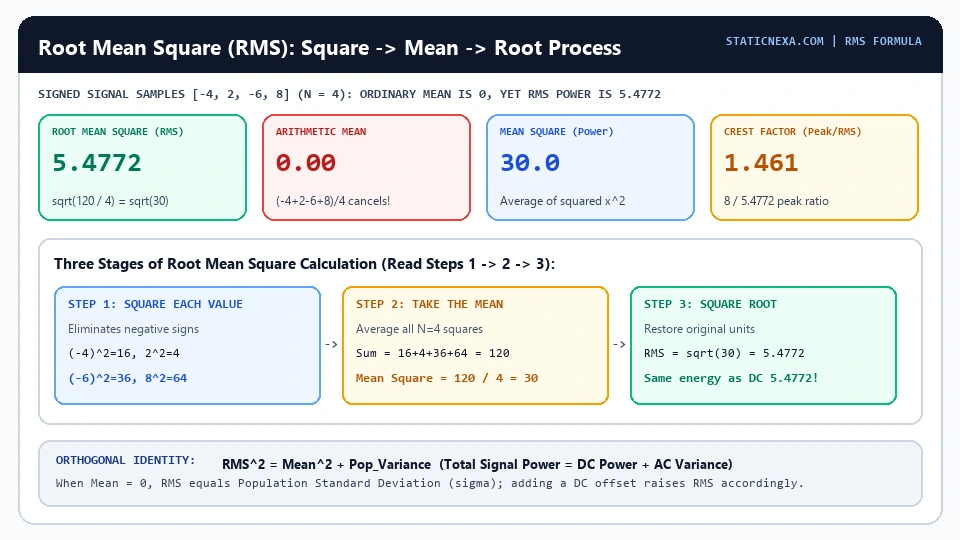
Why RMS = √(Mean² + Variance): The Orthogonal Power Identity
One of the cleanest mathematical theorems in statistics connects Root Mean Square directly to Arithmetic Mean (μ) and Population Variance (σ²):
Look at the two physical extremes revealed immediately by this Pythagorean identity:
- Zero-Mean Oscillating Signal (
μ = 0): When positive and negative swings balance out around zero (like pure AC mains voltage or unbiased prediction errors), RMS equals Population Standard Deviation (σ) identically! Notice in our default dataset[−4, 2, −6, 8], Mean equals0, soRMS = σ = 5.4772. - DC-Biased Signal or Constant Baseline (
σ = 0orμ ≠ 0): Adding a+10VDC offset onto an AC wave adds10² = 100straight to Mean Square power:RMS_total = √(V_dc² + V_ac_rms²), proving why RMS always exceeds or equals both|Mean|andσseparately.
2 Worked Examples
Example 1: Signed Waveform Samples (−4, 2, −6, 8)
Calculate the Root Mean Square, Mean Square, Crest Factor, and DC/AC components of −4, 2, −6, 8:
- Square every observation:
(−4)² = 16,2² = 4,(−6)² = 36, and8² = 64. - Sum all squared values:
16 + 4 + 36 + 64 = 120. - Compute Mean Square: Divide by
N = 4:120 ÷ 4 = 30.0. - Take Square Root:
x_rms = √30 = 5.4772. Meanwhile, the raw Arithmetic Mean equals(−4 + 2 − 6 + 8) ÷ 4 = 0! - Check Crest Factor & Form Factor: Peak magnitude is
|8| = 8, givingCrest Factor = 8 ÷ 5.4772 = 1.4606. Average magnitude is(4 + 2 + 6 + 8) ÷ 4 = 5.0, givingForm Factor = 5.4772 ÷ 5.0 = 1.0954.
Example 2: AC Wall Voltage (170 V Peak) & ML Residual RMSE vs. MAE
Why does a standard North American 120V AC wall outlet actually swing up to ±170 Volts peak? Switch to Mode 2 (AC Waveform Peak ↔ RMS) and type 170:
- Pure Sine Wave RMS:
V_rms = 170 ÷ √2 = 170 × 0.707107 = 120.21 V(producing the exact same Joule heatingV² / Rin a toaster coil or incandescent lamp as a steady120.21 VDC battery!). - Rectified Average & Factors: Rectified DC average equals
2 × 170 ÷ π = 108.23 V, giving standard Sine Crest Factor√2 = 1.4142and Sine Form Factor120.21 ÷ 108.23 = 1.1107. If the same170Vpeak amplitude came from a triangle wave instead, RMS would drop to170 ÷ √3 = 98.15 V! - Machine Learning Error Check (Mode 3): For five residual predictions
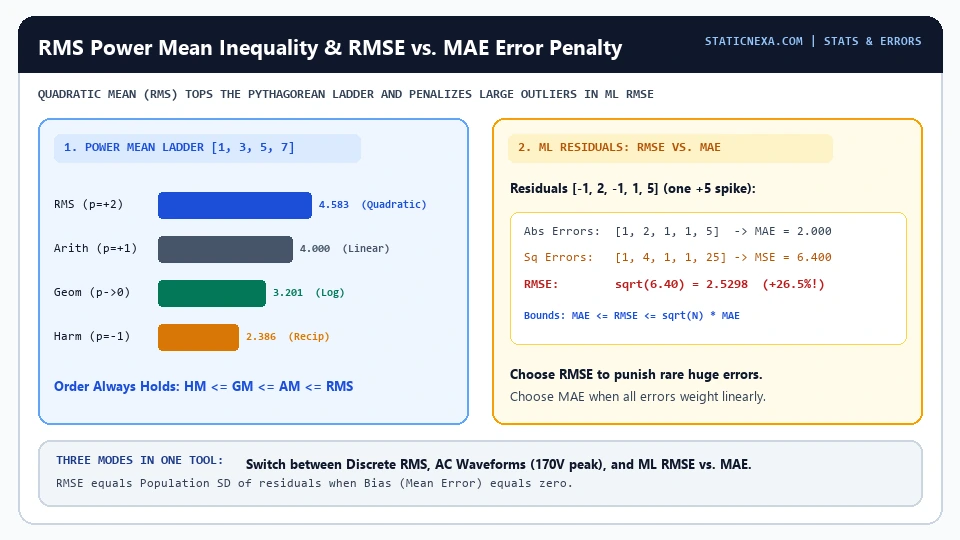
[−1, 2, −1, 1, 5], Mean Absolute Error isMAE = (1+2+1+1+5) ÷ 5 = 2.00, while Mean Squared Error is(1+4+1+1+25) ÷ 5 = 6.40, yielding RMSE = √6.40 = 2.5298 (26.5%higher than MAE because squaring magnifies the single5outlier error!).
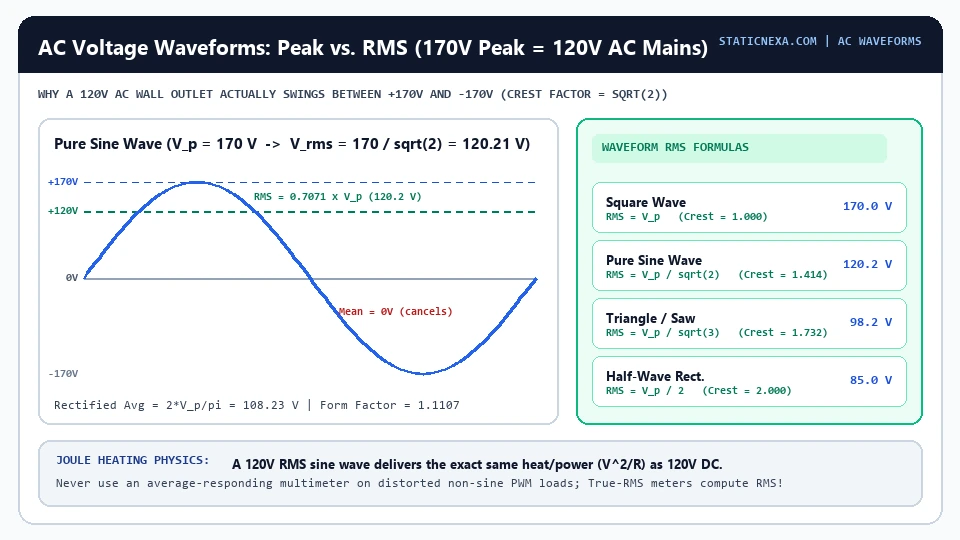
AC Waveform Conversion Table: Crest Factor & Form Factor
In power electronics, audio amplifiers, and True-RMS multimeter design, two dimensionless shape ratios diagnose how "peaky" a waveform is compared to a smooth sine wave:
- Crest Factor (
Peak ÷ RMS): Measures peak headroom needed in amplifiers and power supplies before clipping occurs. High-Crest-Factor audio or switching power supplies draw huge current spikes briefly, requiring larger wire/fuse ratings even at low average current. - Form Factor (
RMS ÷ Rectified_Average): Cheap average-responding multimeters actually measure rectified average and multiply by1.1107assuming a pure sine wave. On square waves (Form Factor1.00) or dimmed TRIAC waveforms, cheap meters read inaccurately; only a True-RMS meter computes the true integral square root!
| Waveform Shape | RMS Formula (from Peak V_p) | Crest Factor | Form Factor |
|---|---|---|---|
| DC / Square Wave (50% Symmetric) | V_p (1.0000 × V_p) | 1.0000 | 1.0000 |
| Pure Sine Wave | V_p ÷ √2 (0.7071 × V_p) | 1.4142 | 1.1107 |
| Triangle / Sawtooth Wave | V_p ÷ √3 (0.5774 × V_p) | 1.7321 | 1.1547 |
| Half-Wave Rectified Sine | V_p ÷ 2 (0.5000 × V_p) | 2.0000 | 1.5708 |
RMS in the Pythagorean Ladder & Machine Learning (RMSE vs. MAE)
Across any positive dataset (such as [1, 3, 5, 7]), RMS represents the p = 2 instance of the Generalized Power Mean M_p = ( (1/N) × Σ xᵢ^p )^(1/p). Because M_p increases strictly with exponent p, RMS always tops the classical inequality ladder: Harmonic (2.386) ≤ Geometric (3.201) ≤ Arithmetic (4.000) ≤ RMS (4.583).
In predictive modeling and statistics, applying RMS to residual prediction errors (eᵢ = yᵢ − ŷᵢ) produces Root Mean Square Error (RMSE). Comparing RMSE against Mean Absolute Error (MAE) immediately reveals error tail behavior because mathematics guarantees MAE ≤ RMSE ≤ √N × MAE: when every error is identical in size, RMSE = MAE; when a model makes mostly small mistakes plus one massive outlier, RMSE ÷ MAE rises sharply toward √N.
RMS Formulas in Excel, Google Sheets & Python
Put your discrete observations or residuals inside cell range A2:A10 and run:
Excel (RMSE between B2:B10 & C2:C10): =SQRT(SUMXMY2(B2:B10, C2:C10) / COUNT(B2:B10))
Python (NumPy): np.sqrt(np.mean(np.square(x)))
Python (RMSE with scikit-learn): root_mean_squared_error(y_true, y_pred)
Notice Excel's built-in SUMXMY2(actual_range, pred_range) function computes the sum of squared differences Σ(xᵢ − yᵢ)² directly in a single call without helper columns!
Continuous Calculus RMS & Kinetic Gas Speed (v_rms)
For continuous analog signals f(t) repeating over period T (from t₁ to t₂), finite discrete summation turns into an integral:
Maxwell Gas Speed: v_rms = √( 3 × R × T ÷ M ) [Nitrogen N₂ at 298 K ≈ 515 m/s]
In physical chemistry, gas molecules collide with kinetic energy proportional to velocity squared (½ m v²). Because average kinetic energy scales with temperature T, computing the exact speed corresponding to average thermal energy requires Root Mean Square molecular speed (v_rms) rather than ordinary arithmetic speed (which runs slightly lower at √(8RT / πM) ≈ 0.921 × v_rms). Meanwhile, audio engineers measure digital signal loudness on logarithmic RMS decibel scales (dBFS = 20 × log₁₀(RMS ÷ Full_Scale)), where a pure full-scale sine wave registers at −3.01 dBFS rather than 0 dBFS peak.
5 Common Root Mean Square Mistakes to Avoid
- Dividing by
N − 1Instead ofN: Unlike Bessel-corrected Sample Standard Deviation, mathematical RMS divides Sum of Squares strictly byN(matching energy per sample and Population SD when Mean = 0). - Using
V_peak ÷ √2on Square or Triangle Waves: Multiplying peak amplitude by0.7071works only for pure sinusoids. Switched PWM signals or triangle waveforms require their own RMS formulas or discrete waveform sampling in Mode 2. - Confusing RMS With Arithmetic Mean of Absolute Values (
MAE): Simply stripping minus signs givesMean(|x|), which equals5.00on[−4, 2, −6, 8]rather than true energy-equivalent RMS (5.4772). - Adding RMS Signals Linearly Without Quadrature (
RMS₁ + RMS₂): Two independent uncorrelated noise sources or orthogonal AC frequencies add by sums of squares:RMS_total = √(RMS₁² + RMS₂²), neverRMS₁ + RMS₂! - Averaging Mean and AC Ripple Incorrectly: To combine a DC voltage
V_dcwith an AC rippleV_ac_rms, use√(V_dc² + V_ac_rms²)rather than arithmetic addition.
Related Statistics & Engineering Calculators
Explore complementary power, spread, and average calculators inside our Math & Statistics hub:
- Standard Deviation Calculator & Variance Calculator: compute Mean-centered spread (
σequals RMS when Mean = 0). - Mean Calculator, Geometric Mean Calculator, and Harmonic Mean Calculator: explore the rest of the Power Mean hierarchy.
- Percent Error Calculator & Z-Score Calculator: check relative experimental errors and standardized residuals.
Verify how Staticnexa tests numerical edge cases and signal identities in our Editorial & Mathematical Accuracy Policy.
Frequently Asked Questions
What is the Root Mean Square (RMS) formula?
RMS equals the square root of the arithmetic mean of squared values: x_rms = sqrt((x1^2 + x2^2 + ... + xN^2) / N). It is also called the Quadratic Mean.
Why do we use RMS instead of Mean for AC voltage and sound?
An AC sine wave spends equal time positive and negative, so its raw arithmetic mean is 0V even though it delivers real heating power. RMS weights amplitude squared (proportional to power V^2/R) and yields the exact DC voltage delivering identical average power.
How do you convert AC Peak voltage to RMS voltage?
For a pure sine wave, divide Peak voltage by sqrt(2) (V_rms = V_peak * 0.707107). A standard North American 120V AC RMS outlet reaches roughly 170V peak (170 / 1.4142 = 120.2V). Square waves use V_rms = V_peak, while triangle waves use V_peak / sqrt(3).
What is the difference between RMS and Standard Deviation?
Population Standard Deviation measures spread around the Mean: sqrt(Sum((x - Mean)^2) / N). RMS measures magnitude around zero: sqrt(Sum(x^2) / N). They obey RMS^2 = Mean^2 + Variance, so RMS equals Population SD whenever the dataset Mean is 0.
How is RMSE different from MAE in Machine Learning?
MAE (Mean Absolute Error) averages absolute errors linearly, whereas RMSE (Root Mean Square Error) squares residuals before averaging and taking the square root. Because squaring amplifies huge errors, RMSE is always >= MAE and penalizes large outlier mistakes more heavily.
What is Crest Factor and Form Factor?
Crest Factor equals |Peak| / RMS (equal to sqrt(2) = 1.4142 for a pure sine wave). Form Factor equals RMS / Rectified_Average (equal to 1.1107 for a sine wave), indicating waveform shape.
Mathematical References & Standards
- Wikipedia: Root Mean Square (Quadratic Mean): Definition, Waveforms & Identities (Mathematical properties, AC voltage derivations, Crest/Form factor formulas, and DC+AC variance identity)
- Wolfram MathWorld: Root-Mean-Square: Generalized Power Mean Formulation (Algebraic formulation as p = 2 power mean and Pythagorean mean bounds)
- Wikipedia: Root-Mean-Square Deviation (RMSE / RMSD) (Properties of RMSE in regression and forecasting versus Mean Absolute Error (MAE))
- Wikipedia: Crest Factor: Peak-to-RMS Ratios Across Waveforms (Standard Crest Factor constants for square, sine, triangle, and audio signals)
- NIST Engineering Statistics Handbook: Section 1.3.5.6: Measures of Scale (Federal statistical reference connecting quadratic scale estimators to standard deviation)