What Is a Ratio? Notation, Proportions & Core Formulas
A ratio compares the relative sizes of two or more quantities, expressing how many times one amount contains or pairs with another. Written classically with a colon (A : B), as a fraction (A / B), or in words ("A to B"), ratios remain invariant whenever every term is multiplied or divided by the exact same nonzero number. When two ratios share equal value, they form a proportion (A : B = C : D).
Solve Missing D or C: D = (B × C) ÷ A | C = (A × D) ÷ B
Simplest Integer Form: Divide all terms by Greatest Common Divisor (GCD)
Part-to-Whole Share Split: Share_i = Total × (Term_i ÷ Sum of All Terms)
Whether you are resizing a 16 : 9 video frame cleanly without cropping, reducing multi-part concrete or financial mixes like 12 : 18 : 24, splitting revenue among cofounders by exact contribution shares, or comparing photography aspect ratios against the Golden Ratio φ ≈ 1.618, ratios unify arithmetic, geometry, and proportional reasoning into one toolkit.
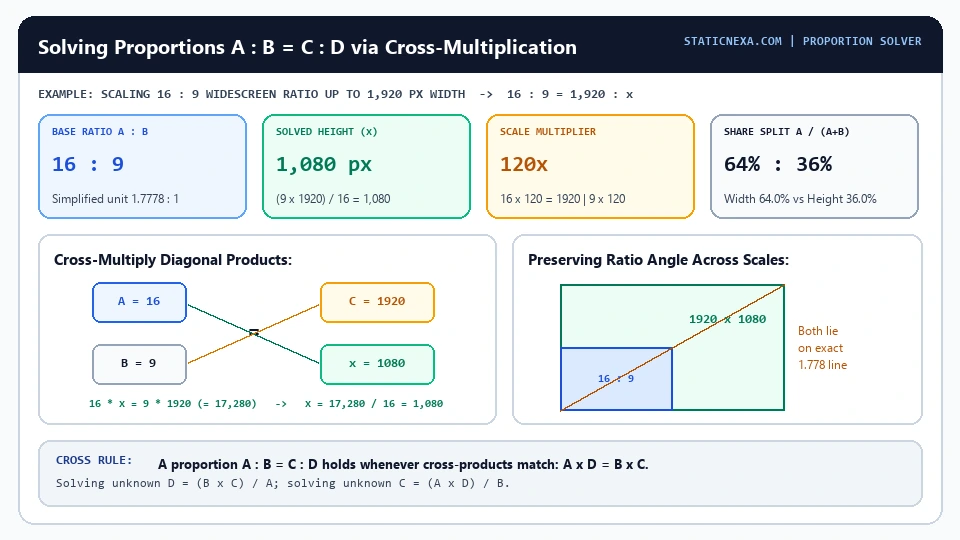
How Cross-Multiplication Solves Any Missing Proportion Value (A : B = C : D)
Given any three known terms of a proportion A : B = C : D, Mode 1 computes the exact unknown fourth number by clearing both denominators across the equals sign: multiplying A / B = C / D by B × D immediately turns fractions into balanced products A × D = B × C. Dividing by the opposite partner isolates your target cleanly:
- Missing last term (
D): Enter1920 : x(or simply1920) against base16 : 9. Multiplying diagonals givesD = (9 × 1920) ÷ 16 = 17,280 ÷ 16 = 1,080. Notice that1920 ÷ 16 = 120×confirms both width and height scaled cleanly by the exact multiplier120. - Missing third term (
C): Enterx : 1440against16 : 9to computeC = (16 × 1440) ÷ 9 = 2,560(standard QHD 1440p monitor width!).
Simplifying 2-Term, Multi-Term & Decimal Ratios + Part-to-Whole Allocation
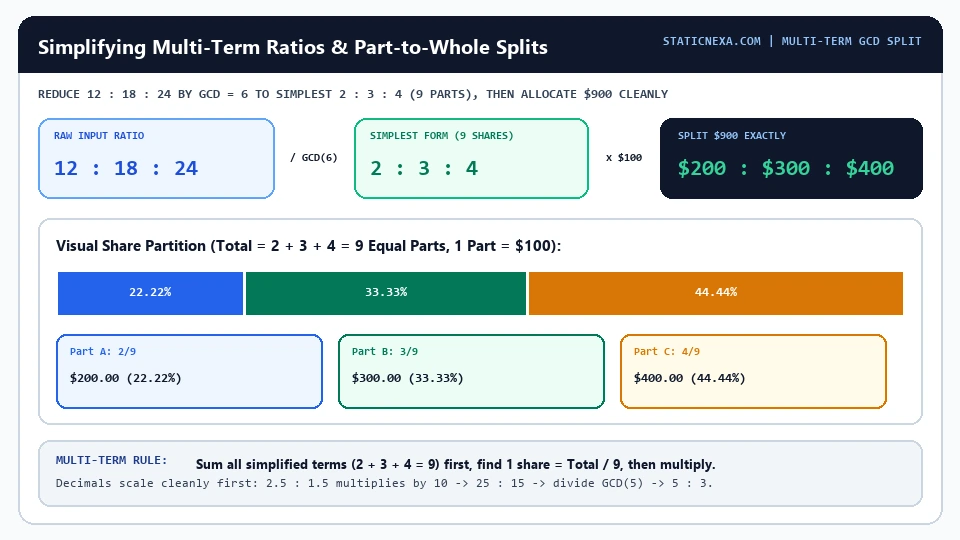
To reduce any integer ratio such as 12 : 18 : 24 to lowest terms, compute the Greatest Common Divisor (GCD) shared by all terms simultaneously. Because GCD(12, 18, 24) = 6, dividing every entry by 6 yields 2 : 3 : 4. What if your inputs contain decimals or fractions, such as 2.5 : 1.5? Simply multiply all terms by a power of 10 until integers appear (×10 -> 25 : 15), then divide by GCD(25, 15) = 5 to reveal 5 : 3!
When dividing a real-world budget, profit pool, or mixture mass proportionally across terms, remember the crucial part-to-whole vs. part-to-part distinction: a 2 : 3 ratio compares 2 units against 3 units (5 total units), meaning the first party owns 2/5 = 40% rather than 2/3 = 66.7%! Adding all terms together first computes the true denominator before allocating exact shares.
Aspect Ratios in Screens, Photography & the Golden Ratio (φ ≈ 1.618)
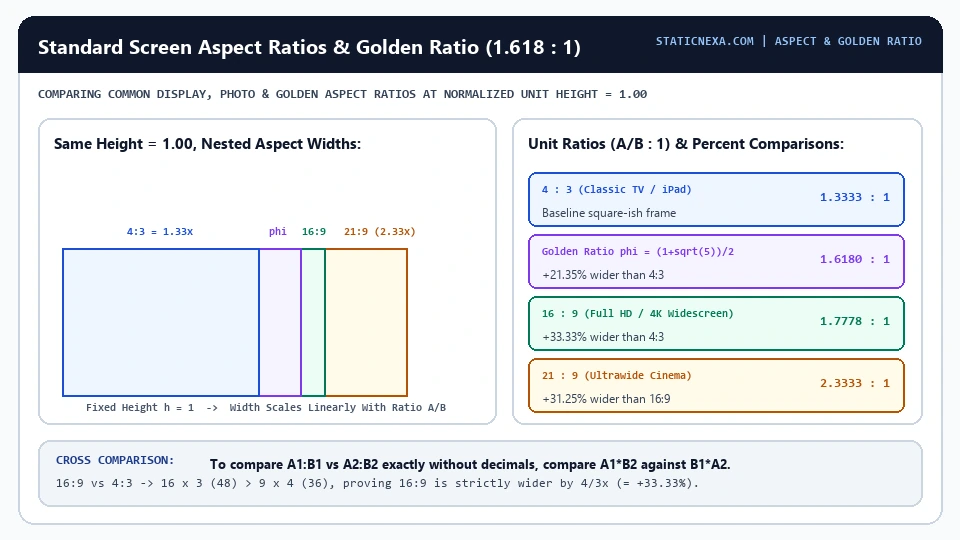
Every screen resolution, camera sensor, and paper standard encodes a geometric aspect ratio (Width : Height). Converting any ratio A : B to its unit ratio (A/B : 1) places completely different formats onto a single objective number line:
| Standard Format | Exact Ratio | Unit Ratio (W/H : 1) |
Part-to-Whole Shares | Typical Applications |
|---|---|---|---|---|
| Classic Photo / Print | 3 : 2 | 1.5000 : 1 | 60.0% / 40.0% | 35mm DSLR cameras, 4×6 & 6×4 prints |
| Classic TV / Tablet | 4 : 3 | 1.3333 : 1 | 57.1% / 42.9% | iPads, Micro Four Thirds sensors, legacy monitors |
Golden Ratio (φ) |
(1+√5) : 2 | 1.6180 : 1 | 61.8% / 38.2% | Architecture, classical spiral layouts, editorial grids |
| Widescreen HD / 4K | 16 : 9 | 1.7778 : 1 | 64.0% / 36.0% | 1080p Full HD, 1440p QHD, 4K UHD TVs & laptops |
| Ultrawide Cinema | 21 : 9 | 2.3333 : 1 | 70.0% / 30.0% | 3440×1440 ultrawide displays, anamorphic cinema |
2 Worked Examples
Example 1: Resizing a 16 : 9 Display Frame & Comparing 16 : 9 vs. 4 : 3
Part A (Solve Missing Height in Mode 1): A video designer exports a 16 : 9 master frame at a new pixel width of 1,920 px. What exact vertical height preserves aspect integrity without black bars or stretching?
- Write the proportion:
16 : 9 = 1,920 : x. - Cross-multiply:
16 × x = 9 × 1,920 = 17,280. - Divide by
16:x = 17,280 ÷ 16 = 1,080 px, confirming an exact scale factor of1,920 ÷ 16 = 120×!
Part B (Compare Ratios in Mode 4): How much wider is a 16 : 9 display compared with a 4 : 3 tablet screen of the exact same physical height? Converting both to unit form yields 1.7778 : 1 vs. 1.3333 : 1. Cross-multiplying 16 × 3 = 48 vs. 9 × 4 = 36 proves 16 : 9 is wider by factor 48 ÷ 36 = 4/3 = 1.3333×, or exactly +33.33% wider!
Example 2: Multi-Term Partnership Split (12 : 18 : 24) & Scaling a Recipe Batch
Part A (Simplify & Allocate in Mode 2): Three co-investors contribute 12, 18, and 24 hours respectively to build a prototype that earns $900 profit. Simplify their contribution ratio and divide the profit fairly:
- Find multi-term GCD:
GCD(12, 18, 24) = 6. - Divide all terms by 6: Simplest ratio becomes
2 : 3 : 4. - Sum total parts:
2 + 3 + 4 = 9equal shares, making each share worth$900 ÷ 9 = $100. - Multiply each term: Investor 1 gets
2 × $100 = $200(22.22%), Investor 2 gets3 × $100 = $300(33.33%), and Investor 3 gets4 × $100 = $400(44.44%).
Part B (Scale Mixture in Mode 3): A standard mortar mix uses cement, sand, and gravel in ratio 3 : 2 : 1 (6 buckets per batch). Quadrupling the batch (k = 4) scales every ingredient proportionally to 12 : 8 : 4 (24 total buckets) while keeping shares fixed at 50% / 33.3% / 16.7%.
Engineering Gear Ratios, Architectural Scales & Financial Multiples
Ratios drive precision across mechanical engineering, cartography, and corporate finance. In a meshed gearbox, the gear ratio (Driven Teeth : Drive Teeth) trades rotational speed inversely for torque: a 45 : 15 = 3 : 1 reduction turns three motor revolutions into one wheel turn while tripling output torque (minus friction losses). Similarly, architectural blueprints use standard scale ratios like 1 : 50 or 1 : 100, where 1 cm on paper maps directly to 100 cm (1 meter) on site via Mode 3 scaling.
In finance and chemistry, standardizing measurements as ratios reveals true efficiency across different company sizes or batch weights: metrics such as Debt-to-Equity (Total Liabilities : Shareholder Equity), Price-to-Earnings (P/E), and stoichiometric molar ratios allow instant apples-to-apples ranking via unit conversion (X : 1) inside Mode 4.
Ratio Formulas in Excel, Google Sheets & Python
Compute greatest common divisors, formatted aspect strings, and scaled proportions inside spreadsheets or Python:
Excel Missing Term D (A:B = C:D): =(B * C) / A
Excel 3-Term Split Share i: =Total * (A1 / SUM(A1:C1))
Python Simplify N-Term Integer: g = math.gcd(*terms); [t // g for t in terms]
Python Fraction Ratio Simplifier: from fractions import Fraction; Fraction(A, B)
5 Common Ratio Mistakes to Avoid
- Confusing Part-to-Part With Part-to-Whole Fractions: A
1 : 3juice concentrate mix means1part syrup plus3parts water =4total parts (25%syrup,75%water), not1/3 = 33.3%syrup! - Adding or Subtracting a Constant Instead of Multiplying: Adding
+2to both sides turns1 : 2into3 : 4(a 50% vs 75% distortion). Equivalent ratios only hold under multiplication or division by the same scale factor. - Comparing Ratios Without Equalizing Units First: Never mix inches and feet or grams and kilograms inside
A : B(30 minutes : 2 hoursmust convert to30 : 120 = 1 : 4, not30 : 2 = 15 : 1!). - Aligning Terms Inconsistently Across Proportions: If your left ratio puts
Width : Height(16 : 9), your right ratio must putWidth : Height(1920 : x), never Height first! - Forgetting Multi-Term GCD Across 3+ Values: Dividing only two terms of
12 : 18 : 25by 6 breaks the third term; every number in a multi-term ratio must be divisible by the same GCD.
Related Percentage, Fraction & Comparison Calculators
Pair ratio scaling and part-to-whole splits with percentage and fraction tools inside our Math & Statistics hub:
- Fraction to Percent Calculator: convert simplified ratio fractions
A / Binto percentages, mixed numbers, and decimals. - Percentage Calculator & What Percent Of Calculator: solve part-to-whole percentages directly.
- Percentage Difference Calculator: quantify symmetric percentage spread between two peer values.
- Weighted Average Calculator: blend values proportionally using custom weight shares.
Learn how Staticnexa validates decimal-to-integer GCD scaling and proportional cross-checks in our Editorial & Mathematical Accuracy Policy.
Frequently Asked Questions
How do you solve a proportion A : B = C : D with one missing number?
Cross-multiply diagonal pairs: A * D = B * C. If D is missing, compute D = (B * C) / A. If C is missing, compute C = (A * D) / B. For example, 16 : 9 = 1920 : x yields x = (9 * 1920) / 16 = 1,080.
How do you simplify a ratio with decimals or 3 numbers?
For decimals like 2.5 : 1.5, first multiply all terms by a power of 10 to clear decimals (25 : 15), then divide all terms by their Greatest Common Divisor (GCD = 5) to get 5 : 3. The same multi-term GCD method reduces 12 : 18 : 24 by 6 to 2 : 3 : 4.
How do you divide a total amount by a ratio?
First add all parts of the ratio to get the total number of shares, divide your starting quantity by that sum to find 1 share, and multiply by each term. Splitting $900 by 2 : 3 : 4 divides $900 by 9 ($100 per share) into $200, $300, and $400.
What is the difference between a part-to-part ratio and a percentage?
A part-to-part ratio compares two separate groups (e.g. 2 apples : 3 oranges). A percentage expresses each part over the combined whole (2/5 = 40% apples and 3/5 = 60% oranges).
How do I compare two ratios like 16:9 vs 4:3 to see which is larger?
Convert each to decimal form A/B (16/9 = 1.7778 vs 4/3 = 1.3333) or cross-multiply A1*B2 vs B1*A2 (16*3 = 48 vs 9*4 = 36). Since 48 > 36, 16:9 is 33.33% wider than 4:3.
What is a 1 : n or n : 1 unit ratio?
A unit ratio divides every term by one side so that side equals 1 (for instance, 16 : 9 becomes 1.7778 : 1, or 1 : 0.5625), making unrelated ratios easy to compare directly.
Mathematical References & Standards
- Wikipedia: Ratio: Notation, Simplification & Part-to-Whole Proportions (Foundational definitions separating part-to-part and part-to-whole comparisons)
- Wikipedia: Proportionality (Mathematics): Direct Scaling & Constant of Proportionality (Formal invariance laws under scalar multiplication k)
- Wikipedia: Cross-Multiplication: Solving Fractional & Ratio Equalities (Algebraic justification of A*D = B*C for solving missing proportion values)
- Wikipedia: Aspect Ratio (Image): Standard 4:3, 16:9 & Cinema Dimensions (Practical display, photography, and video proportion standards)
- Wikipedia: Golden Ratio (phi = 1.618...): Geometry & Classical Proportion (Mathematical derivation of (1 + sqrt(5))/2 aspect benchmark)