Percentage Points vs. Percent Change: Why This Distinction Matters
In finance news, election polls, and conversion analytics, few mistakes cause more confusion than mixing up percentage points (pp) and percentage change (%).
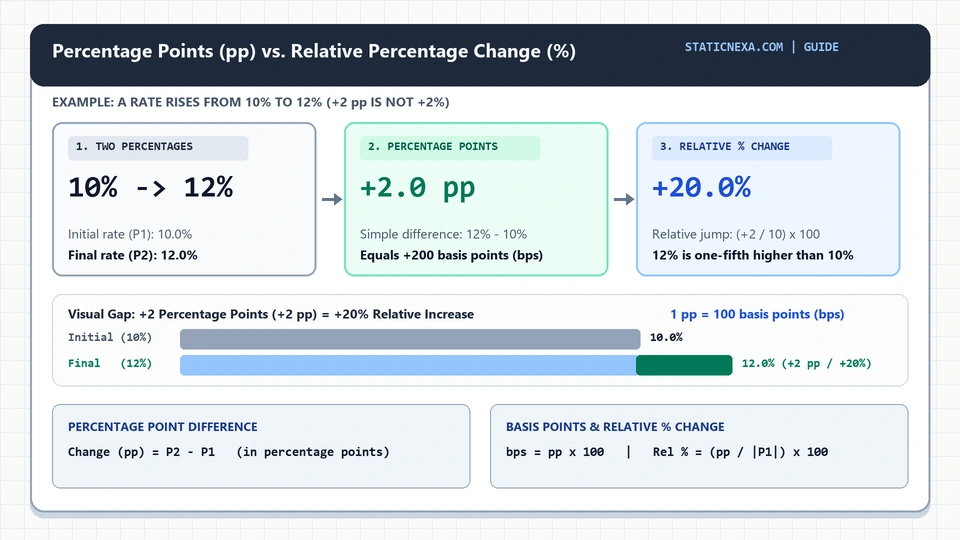
Suppose an interest rate or checkout conversion rate moves from 10% to 12%. Calling that a "2% increase" is misleading because 2% of 10% is only 0.2% (giving 10.2%). In reality, the rate rose by +2 percentage points (+2 pp), which equals a +20% relative increase over the original 10% rate. Our calculator computes both figures side by side, along with basis points (bps), so your reports stay crystal clear.
Percentage Point & Basis Point Formulas
Basis Points (bps): Δbps = (P₂ − P₁) × 100 (1 pp = 100 bps)
Relative % Change: Rel % = ((P₂ − P₁) ÷ |P₁|) × 100
Apply Basis Points: P₂ = P₁ + (bps ÷ 100)
2 Worked Examples
Example 1: Interest Rate or Conversion Rate Rise (10% to 12%)
A site's signup rate improves from 10% in Q1 to 12% in Q2. Measure the shift in percentage points, basis points, and relative percentage change:
- Percentage point change:
12% − 10% = +2 pp(two percentage points higher). - Basis points:
+2 pp × 100 = +200 bps. - Relative percentage change:
(+2 ÷ 10) × 100 = +20%relative lift in signups.
Example 2: Central Bank Policy Rate Cut (5.25% Cut by 50 Basis Points)
Suppose a central bank lowers its benchmark rate from 5.25% by 50 basis points (−50 bps). Find the new rate and relative drop:
- Convert basis points to percentage points:
−50 bps ÷ 100 = −0.50 pp. - Subtract from the starting rate:
5.25% − 0.50% = 4.75%. - Check relative percentage change:
(−0.50 ÷ 5.25) × 100 ≈ −9.524%lower borrowing rate.
Percentage Points vs. Basis Points Reference Table
| Percentage Points (pp) | Basis Points (bps) | Decimal Shift | Common Real-World Use |
|---|---|---|---|
| 0.01 pp | 1 bps | 0.0001 | Bond yields, institutional FX spreads |
| 0.25 pp | 25 bps | 0.0025 | Standard central bank rate hike or cut |
| 0.50 pp | 50 bps | 0.005 | Larger monetary policy adjustment |
| 1.00 pp | 100 bps | 0.01 | 1 full percentage point shift (e.g. 4% to 5%) |
| 2.00 pp | 200 bps | 0.02 | Polling lead or tax-rate bracket change |
A2 (stored as 0.10) and new percentage in B2 (0.12), =(B2-A2)*100 gives the plain number 2 percentage points, while =(B2-A2)/ABS(A2) formatted as % gives the relative 20% change. Compare these calculations directly with our Percentage Change Calculator, Decimal to Percent Calculator, or the full Math Calculators hub.
See our Editorial & Mathematical Accuracy Policy for how we validate edge cases such as 0% starting rates across all Staticnexa tools.
Frequently Asked Questions
What is the difference between percentage points and percent?
Percentage points measure the simple arithmetic subtraction between two percentages (for example, 10% to 12% is +2 percentage points). Percent change measures the relative shift over the starting value ((12 - 10) / 10 = +20%).
How many basis points are in 1 percentage point?
There are exactly 100 basis points (bps) in 1 percentage point (pp). For example, 0.25 percentage points equals 25 basis points, and 2.5 percentage points equals 250 basis points.
Why do central banks and bond traders use basis points instead of percentages?
Basis points eliminate ambiguity. Saying an interest rate rose "by 25 basis points" always means +0.25 percentage points (for example, 5.00% to 5.25%), whereas saying it rose "by 25%" could mean multiplying 5.00% by 1.25 to get 6.25%.
Can percentage point difference be negative?
Yes. When the final percentage is lower than the initial percentage (for example, falling from 5.25% to 4.75%), the difference is negative (-0.5 percentage points, or -50 basis points).
What happens to relative percent change if the starting rate is 0%?
The percentage point difference is still defined (for example, 0% to 3% is +3 pp and +300 bps), while the relative percentage change is undefined because the formula would divide by 0.
Mathematical References & Standards
- Wikipedia: Percentage Point: Definition & Contrast With Percentage Change (Standard terminology, notation (pp / pct pts), and polling/finance examples)
- Wikipedia: Basis Point (bps): Relationship to Percentage Points (Formal definition showing 1% = 1 percentage point = 100 basis points)
- Wikipedia: Relative Change and Difference (Distinction between absolute differences in percentages and relative change)
- Board of Governors of the Federal Reserve System: Open Market Operations & Policy Rate Actions (Real-world monetary policy rate targets reported in percentage points and basis points)