What This All-in-One Percentage Calculator Solves
Almost every everyday percentage question boils down to one of four simple sentences: finding a percentage of a number (what is 25% of 200?), finding what share one value represents out of another (45 is what percent of 180?), measuring growth or drop between an old and new figure (what is the percentage increase or decrease from 80 to 100?), or working backward from a known slice to recover the original total (30 is 15% of what number?).
Instead of forcing you to open four different tabs, all four calculators live together right at the top of this page. Type into any sentence box and its answer updates on the spot, while the Math Notebook and visual scale bar automatically follow whichever calculation row you clicked or edited last.
The Percent Triangle & All Four Core Formulas
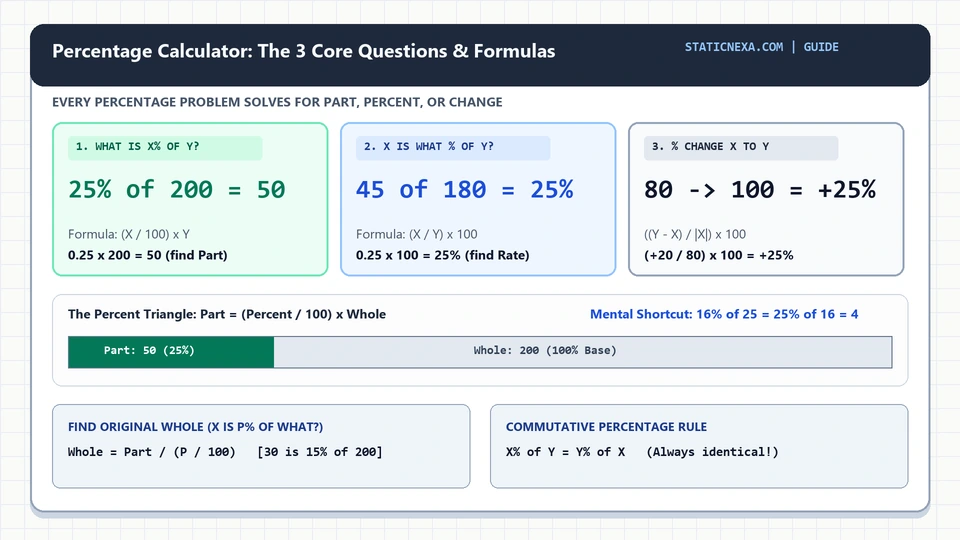
Every basic percentage equation connects three pieces: the Part, the Whole (Base), and the Percent Rate. Once you know any two, you can solve for the third without memorizing separate tricks:
2) A is what percent of B? Percent (%) = (A ÷ B) × 100
3) % Increase / Decrease (X to Y): % Change = ((Y − X) ÷ |X|) × 100
4) A is P% of what total? Whole = A ÷ (P ÷ 100)
- Finding a percentage of a value: Turn the percentage into a decimal by dividing by 100, then multiply by your starting number. For example,
25%becomes0.25, and0.25 × 200 = 50. - Finding what percent one number is of another: Divide the smaller or target share by the total whole, then multiply by 100. For example,
45 ÷ 180 = 0.25, and0.25 × 100 = 25%. - Finding percentage increase or decrease: Subtract the starting number from the ending number, divide by the absolute starting number
|X|, and multiply by 100. Positive answers indicate an increase; negative answers indicate a decrease. - Finding the unknown whole from a part and rate: Divide the known part by the decimal percentage rate. If
30represents15%of a budget,30 ÷ 0.15 = 200.
2 Worked Examples
Example 1: Restaurant Tip & Budget Share (Finding Part and Finding Percent)
Suppose you go out for dinner and the pre-tax bill comes to $150.00. You want to leave an 18% tip, and you also notice that $45.00 of a separate $180.00 monthly dining budget was spent on coffee.
- What is 18% of $150? Convert
18%to0.18and multiply:0.18 × 150 = $27.00tip (bringing the bill with tip to$177.00). - $45 is what percent of $180? Divide the coffee spending by the monthly budget:
45 ÷ 180 = 0.25. Multiply by 100 to find that coffee makes up exactly 25% of the dining budget.
Example 2: Percentage Increase/Decrease & Reverse Whole (80 to 100, Plus 15% of What?)
Imagine an online shop sees daily orders rise from 80 on Monday to 100 on Tuesday, then dip back from 100 to 80 on Wednesday. Later, you read that 30 returned orders represented 15% of weekly shipments.
- Monday to Tuesday (80 to 100):
((100 − 80) ÷ 80) × 100 = (20 ÷ 80) × 100 = +25%increase. - Tuesday to Wednesday (100 to 80):
((80 − 100) ÷ 100) × 100 = (−20 ÷ 100) × 100 = −20%decrease. Notice how going back down uses100as the starting base rather than80, which is why +25% up and −20% down return to the same point! - 30 is 15% of what number? Divide 30 by
0.15:30 ÷ 0.15 = 200total weekly shipments.
Mental Math Shortcuts You Can Use Anywhere
Even without pulling out your phone, you can solve almost any percentage in seconds by breaking it into friendly 10%, 5%, and 1% building blocks:
- The 10% Slide: To find
10%of any number, move the decimal point one place to the left. For example,10% of 240is24, and10% of 68is6.8. - Build 15%, 20%, or 30% From 10%: Need a 15% tip on
$80? Take10% ($8)plus half of that for5% ($4)to get$12immediately. Need 20%? Double10% ($8 × 2 = $16). - The 1% Rule for Exact Numbers: Move the decimal two places left to get
1%(1% of 350 = 3.5), then multiply by whatever rate you want (3% of 350 = 3 × 3.5 = 10.5). - The Commutative Flip Trick (
X% of Y = Y% of X): Because multiplication order never changes the result ((X ÷ 100) × Y = (Y ÷ 100) × X), you can always swap the two numbers whenever one direction looks awkward! Asked for 16% of 25? Flip it to 25% of 16, which is instantly one quarter of 16: 4. Asked for 8% of 50? Flip it to 50% of 8, which is instantly 4.
Quick Percentage, Decimal & Fraction Reference Table
Memorizing the common fractions behind everyday percentages makes quick price comparisons and chart reading effortless:
| Percentage | Decimal Multiplier | Simplified Fraction | Example on 200 |
|---|---|---|---|
| 1% | 0.01 | 1/100 | 2 |
| 5% | 0.05 | 1/20 | 10 |
| 10% | 0.10 | 1/10 | 20 |
| 12.5% | 0.125 | 1/8 | 25 |
| 20% | 0.20 | 1/5 | 40 |
| 25% | 0.25 | 1/4 | 50 |
| 33.33% | 0.3333… | 1/3 | 66.67 |
| 50% | 0.50 | 1/2 | 100 |
| 66.67% | 0.6667… | 2/3 | 133.33 |
| 75% | 0.75 | 3/4 | 150 |
| 100% | 1.00 | 1/1 | 200 |
5 Common Percentage Mistakes to Avoid
- Confusing "Percent Of" With "Percent Increase": Taking
20% of 100gives20, whereas increasing100by20%gives120. Whenever you want to add or subtract a percentage from a base price, use our Percentage Increase Calculator or Percentage Decrease Calculator. - Adding and Subtracting the Same Percentage: Raising
100by20%gives120, and then subtracting20%of120removes24, leaving96instead of returning to100. Each move applies to a different starting base. - Mixing Up Percentage Points and Percentage Change: When a rate moves from
10%to12%, it gained 2 percentage points, which is a +20% relative increase. Compare both side by side in our Percentage Point Calculator. - Dividing by Zero in Change or Share Queries: Asking "what percent of 0 is 5?" or "what is the percentage change from 0 to 50?" divides by zero, which has no finite answer. Our calculator marks zero-denominator cases as Undefined instead of outputting misleading symbols.
- Adding Stacked Discounts Together: Taking
25% offplus an extra10% couponequals32.5%total savings, not35%, because the second discount applies to the already-reduced price. Use our Percent Off Calculator to test stacked shopping coupons.
How Percentages Work in Finance, Shopping, and Daily Decisions
Almost every practical financial decision relies on translating one of these four percentage questions into real numbers. Knowing which base value acts as the 100% reference point keeps you from mispricing products, underestimating bills, or misreading growth headlines.
Sales Tax, Restaurant Tips, and Sequential Calculations
Suppose your restaurant bill totals $80.00 before tax, local sales tax is 8.5%, and you want to leave an 18% tip on the pre-tax subtotal. Both tax and tip apply directly to the same $80.00 starting base, so you calculate 8.5% of 80 = $6.80 for tax and 18% of 80 = $14.40 for tip, bringing the combined total to $101.20.
Notice what happens if you instead tip 18% after adding sales tax: 18% of $86.80 equals $15.62. Always check whether a second percentage applies to the original base or the updated subtotal. When shopping online with an instant percentage discount followed by sales tax, notice that applying a 20% discount (multiplying by 0.80) and then adding 8% sales tax (multiplying by 1.08) gives the multiplier 0.80 × 1.08 = 0.864, which is lower than 0.80 + 0.08 = 0.88 because tax is charged on the discounted price rather than the original tag price.
Gross Margin vs. Markup in Pricing
Small business owners and freelancers often mix up markup and profit margin, even though both use percentages from different denominators. Suppose a retailer buys a desk lamp at a wholesale cost of $100 and marks it up by 25% to sell it for $125. Using Row 3 (What is the percentage change from 100 to 125?), the markup over cost is +25%. However, if you use Row 2 (25 is what percent of 125?) to measure profit as a share of the selling price, the gross margin is only 20%. Row 4 solves the reverse question as well: if you want a $30 gross profit to represent a 20% margin, type 30 is 20% of what number? to discover that the retail selling price must be $150.
Absolute Gains vs. Relative Percentage Growth
Percentage change always depends on where you started. Adding 8 new customers means two very different things depending on scale: moving from 4 to 12 customers is a +200% surge, while moving from 400 to 408 customers is a modest +2% increase, even though the absolute gain is identical. Pairing the inline percentage output in Row 3 with the absolute difference displayed on the main calculator screen lets you judge both the relative rate and the real-world magnitude side by side before making budget or inventory decisions.
Percentage Formulas for Excel & Google Sheets
Working in a spreadsheet? Remember that Excel and Google Sheets treat a cell formatted as Percent (%) as its underlying decimal (25% is stored as 0.25). Use these exact formulas:
A is what % of B (format result as %): =A2/B2
% Change from A to B (format result as %): =(B2-A2)/ABS(A2)
A is P% of what? (B2 formatted as %): =A2/B2
Specialized Percentage & Math Calculators on Staticnexa
If your problem goes deeper than these four core questions, jump straight to a dedicated tool in our Math Calculators hub:
- Percentage Change Calculator: full directional breakdown including negative starting values.
- Percentage Increase Calculator and Percentage Decrease Calculator: add or subtract percentages and recover pre-tax or pre-discount totals.
- Percent Off Calculator: retail sale prices, savings, and stacked coupons.
- Decimal to Percent and Fraction to Percent: convert decimals, mixed numbers, and basis points.
- Percent Error, Percentage Point, and Grade Percentage: specialized lab, financial rate, and academic tools.
You can read how we verify formulas and edge cases across every tool in our Editorial & Mathematical Accuracy Policy.
Frequently Asked Questions
How do you find what percent one number is of another?
Divide the part value by the whole value and multiply by 100. For example, to find what percent 45 is of 180, divide 45 by 180 to get 0.25, then multiply by 100 to get 25%.
How do you calculate X percent of a number?
Divide the percentage by 100 to convert it into a decimal, then multiply by your number. For example, 25% of 200 is (25 / 100) x 200 = 0.25 x 200 = 50.
How do you calculate percentage increase or decrease between two numbers?
Subtract the starting value from the ending value, divide by the absolute starting value, and multiply by 100: ((New - Old) / |Old|) x 100. A positive result is an increase; a negative result is a decrease.
Why does X% of Y always equal Y% of X?
Because multiplication is commutative: (X / 100) x Y equals (X x Y) / 100, which is identical to (Y / 100) x X. For example, 16% of 25 equals 25% of 16, which is 4.
How do you find the total number if you know a part and its percentage?
Divide the known part by the percentage expressed as a decimal (P / 100). If 30 is 15% of an unknown total, divide 30 by 0.15 to get 200.
Why can percentages go above 100% or below 0%?
Percentages above 100% represent values larger than the original whole (for example, 300 is 150% of 200, or a +150% growth). Negative percentages represent decreases or drops below a starting baseline.
Mathematical References & Standards
- OpenStax Prealgebra (2e): Section 6.1: Understand Percent (Open textbook foundation on per-centum definitions and percent equivalents)
- OpenStax Prealgebra (2e): Section 6.2: Solve General Applications of Percent (Textbook examples solving for Part, Percent, Whole, and Percent of Change)
- Khan Academy: Converting Between Percents, Fractions, and Decimals (Practice exercises and conceptual explanations for percent conversions)
- Wikipedia: Percentage: Calculations, Notation & Properties (Comprehensive reference on percentage arithmetic and everyday applications)