How the "What Percent Of" Calculator Works
Asking "A is what percent of B?" (or "What percent of B is A?") is the fastest way to turn any pair of numbers into a clear proportion out of 100. Whether you are checking an exam score, measuring how much of your paycheck goes toward rent, calculating tax-deductible shares, or seeing what portion of a project is complete, converting raw counts into percentages puts apples and oranges on a shared 0 to 100 scale.
In addition to solving the main share percentage, our calculator computes the underlying decimal ratio, the simplified fraction (for example 1/4), the complement percentage remaining to reach 100%, and permille (per 1,000) automatically. Switch tabs anytime to compute the reverse check (What is P% of B?) or recover a missing total (A is P% of what?).
The "What Percent Of" Formula
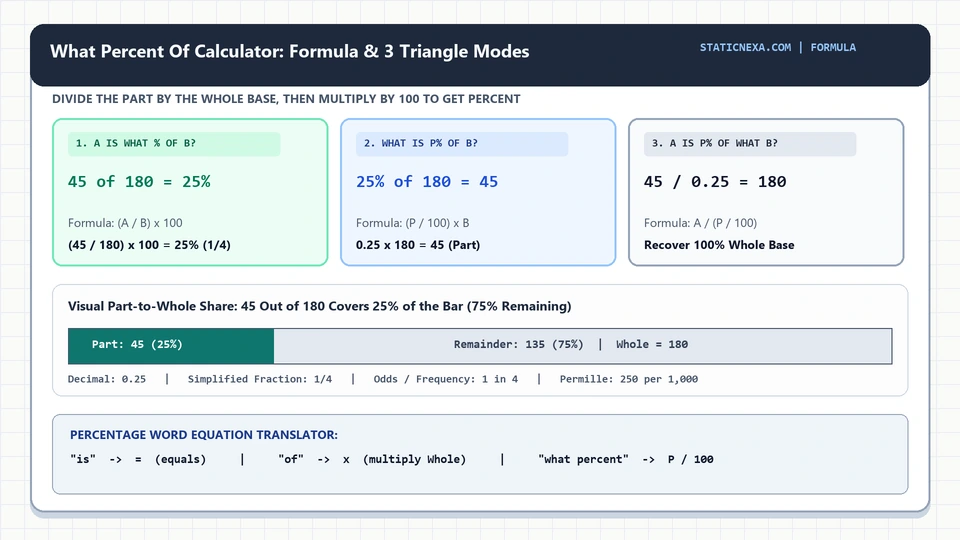
To find what percent number A is of number B, divide A (the Part) by B (the Whole), and then multiply the decimal result by 100:
2) What is P% of B? Part = (P ÷ 100) × B
3) A is P% of what total? Whole = A ÷ (P ÷ 100)
- Step 1 (Divide): Divide the target value
Aby the reference totalB. For45out of180,45 ÷ 180 = 0.25. - Step 2 (Scale to 100): Multiply by 100 to shift the decimal two places right:
0.25 × 100 = 25%. - Complement Share: Subtracting your answer from 100% immediately tells you the leftover portion:
100% − 25% = 75%(which equals135out of180).
Decoding the Words: "Is" and "Of" Always Tell You Where Numbers Go
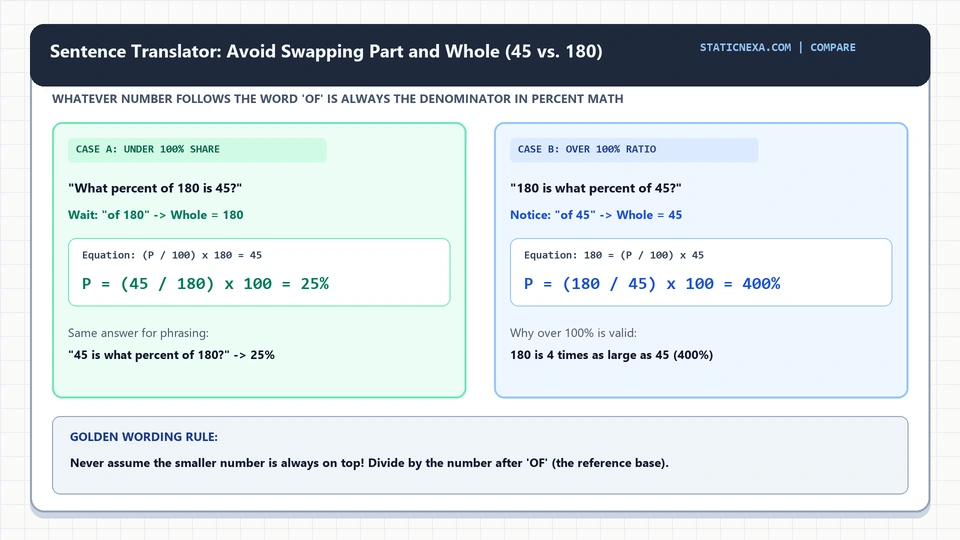
The single biggest source of confusion with "what percent" questions is sentence order. People read a phrase like "180 is what percent of 45?" and instinctively put the smaller number on top (45 ÷ 180) instead of following the math grammar.
Remember two reliable translation keywords that work in every word problem:
- The word "of" translates to multiplication with the Whole Base (meaning the number directly following "of" always belongs in the denominator when solving for
%). - The word "is" translates to the equals sign
=.
2 Worked Examples
Example 1: Monthly Budget Share & Exam Score (Part Smaller Than Whole)
Suppose your monthly grocery receipt totals $450 out of a $1,800 household spending budget, and you want to know what percent of your total spending went to groceries. Meanwhile, you check that you earned 45 points out of 60 on a quiz.
- Grocery share ($450 out of $1,800): Divide the grocery spend (
450, the Part) by total spending (1,800, following "of"):450 ÷ 1,800 = 0.25. Multiply by 100 to get 25% (simplified fraction1/4), leaving 75% ($1,350) for other categories. - Quiz score (45 out of 60): Divide points earned by maximum possible points:
45 ÷ 60 = 0.75. Multiply by 100 to get 75% (or check more grading details in our Grade Percentage Calculator).
Example 2: Ratios Above 100% & Reverse Whole Recovery (180 vs. 45 and 15% Commission)
Imagine a boutique café sold 180 iced drinks today compared with 45 hot teas. You want to express iced drink volume as a percentage of tea volume. Later, an employee earns $36 on a flat 15% commission and asks what total sales generated that payout.
- Iced drinks vs. hot teas ("180 is what percent of 45?"): Because
45follows the word "of", put45in the denominator:180 ÷ 45 = 4. Multiply by 100 to get 400%! Iced drink sales are 4 times hot tea sales (meaning 400% of tea volume, or +300% more than tea volume). - Finding total sales ($36 is 15% of what?): Switch to the third tab (
A is P% of What?) and divide the$36commission by0.15:36 ÷ 0.15 = $240in total sales.
Quick Benchmark Ratios & Fraction Equivalents
Recognizing everyday fractions instantly helps you estimate "what percent of" problems on the fly before typing anything into a device:
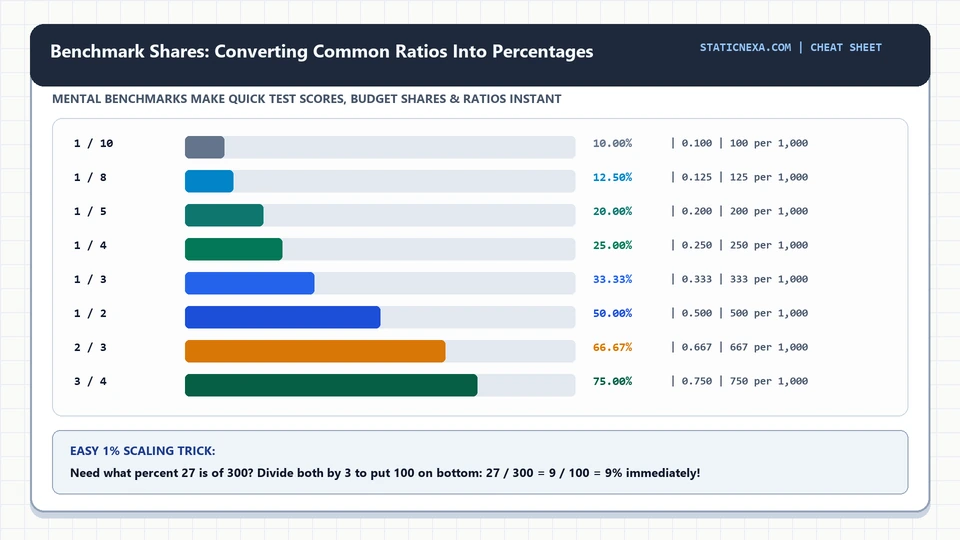
| Part / Whole Example | Simplified Fraction | Decimal | Percentage | Permille (per 1,000) |
|---|---|---|---|---|
| 9 / 90 | 1/10 | 0.1 | 10% | 100‰ |
| 25 / 200 | 1/8 | 0.125 | 12.5% | 125‰ |
| 18 / 90 | 1/5 | 0.2 | 20% | 200‰ |
| 45 / 180 | 1/4 | 0.25 | 25% | 250‰ |
| 40 / 120 | 1/3 | 0.3333… | 33.33% | 333.3‰ |
| 75 / 150 | 1/2 | 0.5 | 50% | 500‰ |
| 90 / 120 | 3/4 | 0.75 | 75% | 750‰ |
| 150 / 100 | 3/2 | 1.5 | 150% | 1,500‰ |
Mental Math Shortcuts for Finding "What Percent"
When you want a fast mental estimate without opening a calculator, two simple fraction tricks handle most real-world denominators:
- Scale the Denominator to 100: Percent literally means per hundred. If your denominator is a clean factor or multiple of 100, scale both numbers together! Asked "14 is what percent of 50?" Double top and bottom (
28 / 100) to get 28% immediately. Asked "18 is what percent of 25?" Multiply both by 4 (72 / 100) to see 72%. - Divide by a Clean Multiple: Asked "27 is what percent of 300?" Divide top and bottom by 3 (
9 / 100) to get 9% instantly. - Estimate Using 10% and 1% Anchor Chunks: Asked "38 is what percent of 200?" Notice
10%of200is20and1%is2. So38is20 + 18, giving10% + 9% = 19%exact!
Real-World Uses: Budgets, Grades, Conversion Rates & Yield
Converting a raw slice into a percentage of a total shows up across personal finance, education, marketing analytics, and operations because percentages standardize numbers of completely different sizes:
- Personal Savings & Housing Ratios: Financial planners recommend keeping monthly housing costs below
28%to30%of gross income. If your rent is$1,450on a$5,000paycheck, checking1,450 ÷ 5,000 × 100gives 29%, telling you right away where your budget stands. - Standardized Test & Assignment Weighting: Comparing a
38/45lab quiz (84.44%) with a76/90midterm (84.44%) reveals identical proportional mastery even though the total points doubled. - Marketing Click-Through & Conversion Rates: An email campaign generating
360clicks from12,000delivered messages achieved a(360 ÷ 12,000) × 100 = 3%click-through rate, letting teams compare small newsletter blasts fairly against million-user campaigns. - Manufacturing Pass Yield & Completion Tracking: If a factory inspects
2,400units and finds2,364pass inspection without defects, the first-pass yield is(2,364 ÷ 2,400) × 100 = 98.5%, while the scrap defect share is the remaining complement of 1.5%.
Formulas for Excel & Google Sheets
In spreadsheets, divide column A (Part) by column B (Whole) and apply Percentage number formatting (%), which automatically multiplies the displayed decimal by 100:
Return plain number (e.g. 25 instead of 25%): =(A2/B2)*100
Zero-safe version avoiding #DIV/0! error: =IF(B2=0,"Undefined",A2/B2)
Find P% of B (when B2 is formatted as %): =B2*C2
5 Common Mistakes to Avoid
- Reversing Numerator and Denominator: Putting the larger number in the denominator automatically breaks questions like
"180 is what percent of 45?". Always keep the value after "of" on the bottom. - Confusing "What Percent Of" With "Percent More Than": If
B = 100andA = 125, thenAis 125% ofB, which is 25% more thanB. Saying "125% more than 100" actually means225! Use our Percentage Increase Calculator whenever measuring growth above a baseline. - Forgetting to Multiply by 100: Dividing
45 ÷ 180produces the decimal0.25, not0.25%(which is tiny: one quarter of one percent!). Always multiply decimal ratios by 100 before appending the%sign. - Dividing by Zero Total: Asking
"12 is what percent of 0?"has no finite solution because zero wholes cannot be split into shares. Our calculator catchesB = 0and displays a clear Undefined notice. - Treating Different Denominators as Directly Comparable Raw Counts: Scoring
36/40(90%) beats scoring42/50(84%) even though42raw points exceeds36. Always convert shares into percentages before ranking outcomes across unequal totals.
Related Math & Percentage Calculators
Switch effortlessly between related tools in our Math Calculators hub:
- All-in-One Percentage Calculator: solve all four classic percentage rows simultaneously on one screen.
- Fraction to Percent Calculator: handle mixed numbers and exact fraction formatting.
- Decimal to Percent Calculator: convert between decimals, percentages, basis points, and permille.
- Reverse Percentage Calculator: undo tax, VAT, or retail discounts to recover original prices.
See how Staticnexa tests precision and edge cases across all tools in our Editorial & Mathematical Accuracy Policy.
Frequently Asked Questions
How do you calculate what percent one number is of another?
Divide the first number (the part) by the second number (the whole, after the word "of") and multiply by 100. For example, 45 is what percent of 180? Compute (45 / 180) x 100 = 0.25 x 100 = 25%.
Which number goes on the bottom (denominator) in "what percent of" questions?
The number following the word "of" always goes in the denominator. In "What percent of 180 is 45?", 180 follows "of", giving 45 / 180 = 25%. In "180 is what percent of 45?", 45 follows "of", giving 180 / 45 = 400%.
Can "A is what percent of B?" be greater than 100%?
Yes. Whenever the part value A is larger than the reference base B (for example, 180 compared against 45), the result exceeds 100% (180 / 45 x 100 = 400%).
How do I type "what percent of" into Excel or Google Sheets?
Enter =A2/B2 where A2 is the part and B2 is the whole, then apply the Percent (%) cell format, or use =(A2/B2)*100 to display the plain percentage number.
What is the difference between "is 125% of" and "125% increase"?
125 is 125% of 100 (just 1.25 times 100), whereas a 125% increase on top of 100 adds 125 to give 225.
Why does the calculator show Undefined when the second number is 0?
Because calculating what percent A is of B requires dividing A by B. Division by zero has no finite mathematical value.
Mathematical References & Standards
- OpenStax Prealgebra (2e): Section 6.1: Understand Percent (Textbook definition of percent as parts per hundred and ratio/decimal equivalents)
- OpenStax Prealgebra (2e): Section 6.2: Solve General Applications of Percent (Translating "is", "of", and "what percent" sentences into Part = Percent x Whole equations)
- Khan Academy: Finding Percents: Part-to-Whole Practice & Word Problems (Worked examples solving for missing percent, part, or whole values)
- Wikipedia: Percentage: Definition, Properties & Applications (Overview of percentage calculations, benchmarks, and multi-unit equivalents)