Three Everyday Questions This Calculator Solves
People rarely search for "percentage increase" for just one reason. Sometimes you already have before-and-after numbers (like last year's rent vs. this year's rent) and want the growth rate. Other times you need to add a known percentage (like an 8% salary raise or a 15% service tip), or work backward from a final bill that already includes tax.
That is why this tool packs all three workflows into the mode tabs at the top, updating the Math Notebook line by line for whichever one you pick. Need to measure a price drop or apply a store discount instead? Switch to our Percentage Decrease Calculator, or use our Percentage Change Calculator when values move both up and down across periods. You can also compare all percentage tools on our Math Calculators hub.
The Three Percentage Increase Formulas
2) Add P% to Base: Final = Original × (1 + P ÷ 100)
3) Reverse Original: Original = Final ÷ (1 + P ÷ 100)
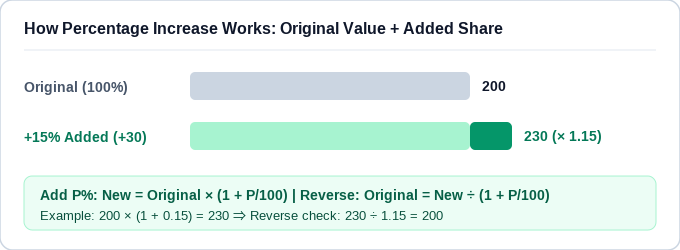
Notice how modes 2 and 3 both hinge on the growth multiplier (1 + P ÷ 100). Adding 15% in one step simply means multiplying by 1.15, because you keep 100% of the original value (1.00) plus the added 15% (0.15).
Common Growth Multipliers Reference Table
Keeping the decimal multiplier in mind makes mental math and spreadsheet modeling much faster:
| Increase (%) | Multiplier (1 + P/100) | Example on 200 | Reverse Check (Final ÷ Multiplier) |
|---|---|---|---|
| +5% | × 1.05 | 210 | 210 ÷ 1.05 = 200 |
| +10% | × 1.10 | 220 | 220 ÷ 1.10 = 200 |
| +15% | × 1.15 | 230 | 230 ÷ 1.15 = 200 |
| +25% | × 1.25 | 250 | 250 ÷ 1.25 = 200 |
| +50% | × 1.50 | 300 | 300 ÷ 1.50 = 200 |
| +100% | × 2.00 | 400 | 400 ÷ 2.00 = 200 |
4 Real-World Pitfalls to Watch Out For
1. The Reverse-Increase Trap (Why Subtracting Gives the Wrong Answer)
$34.50), you get $195.50, which is wrong because 15% of 195.50 is only $29.33, not enough to reach $230. Instead, divide by the multiplier 1.15: 230 ÷ 1.15 = $200.
2. Markup vs. Gross Profit Margin
In retail and freelancing, mixing up markup percentage and gross margin is a costly mistake. If an item costs you $100 and you sell it for $150, your percentage increase (markup) on cost is ($50 ÷ $100) × 100 = 50%. Your gross profit margin, however, divides profit by the selling price: ($50 ÷ $150) × 100 = 33.33%. Always double-check whether a pricing target refers to markup on cost or margin on revenue.
3. Successive Increases Compound Instead of Simply Adding
If a subscription price rises by 10% this year and another 10% next year, the combined increase is not 20%. It is 21%. That is compound growth at work: 1.10 × 1.10 = 1.21. Each new increase builds on the already-raised total rather than the original starting point.
4. What If the "New Value" Is Lower Than the Original?
If you enter a smaller ending number in Find % Increase mode (for example, 200 → 160), our calculator flags it clearly as a negative growth rate (−20%) instead of hiding the sign. For full negative-number and zero-baseline rules, see our Editorial & Mathematical Accuracy Policy.
Excel & Google Sheets Formulas
You can replicate all three calculator modes directly in Excel or Google Sheets (replace P with a decimal like 0.15 or a percent-formatted cell):
Add P% to Original: =Original * (1 + P)
Find Original Value: =Final / (1 + P)
Frequently Asked Questions
How do I add 15% to a number quickly?
Convert 15% to a decimal (0.15), add 1 to get the multiplier 1.15, and multiply your starting number by 1.15. For example, 200 x 1.15 = 230.
How do I find the original number before a percentage increase?
Divide the final value by (1 + P/100). For instance, if a total is 230 after a 15% increase, divide 230 by 1.15 to recover the original value of 200.
What is the difference between a 50% markup and a 50% profit margin?
A 50% markup adds 50% of your cost onto the cost (a $100 cost becomes $150, giving a 33.3% gross margin). A 50% profit margin means profit equals half of the selling price ($100 cost sold for $200, which is a 100% markup).
Why do two consecutive 10% increases equal 21% instead of 20%?
Because the second 10% applies to the already-increased amount (110% of the start). Multiplying the growth factors 1.10 x 1.10 equals 1.21, which is a 21% total increase.
What does a 100% increase mean?
A 100% increase adds an amount equal to the original value, doubling it (multiplier x 2). A 200% increase triples the starting value (multiplier x 3).
Mathematical References & Standards
- OpenStax Prealgebra (2e): Section 6.3: Solve Sales Tax, Commission, and Discount Applications (Markups & Retail Pricing) (Open textbook covering sales tax, commission, and retail markup equations)
- Khan Academy: Percentage Change Review & Percent Increase Word Problems (Worked examples for percentage increase and growth multipliers)
- Wikipedia: Markup (Business): Cost-Plus Pricing vs. Gross Margin (Formal distinction between markup percentage on cost and margin on selling price)
- U.S. Bureau of Labor Statistics: Consumer Price Index (CPI) Overview (Real-world inflation and price-index percentage change reporting)