How the Percent Off Calculator Works
Whether a tag says 30% off or a checkout banner offers 25% off plus an extra 10% coupon, calculating your real out-of-pocket price comes down to multiplying by what you still pay rather than guessing savings in your head.
This calculator handles all three everyday shopping and pricing questions in one place: finding the final sale price (with or without a second stacked coupon), checking what percent off a markdown actually is, and recovering the original sticker price from a sale tag. For general non-retail numeric reductions or multi-year asset depreciation, see our Percentage Decrease Calculator, or compare growth and swings with our Percentage Increase and Percentage Change tools on the Math Calculators hub.
Percent Off Formulas
Money Saved: Savings = Original × (D₁ ÷ 100)
Stacked Extra Coupon: Final Price = Original × (1 − D₁ ÷ 100) × (1 − D₂ ÷ 100)
Find % Off: % Off = ((Original − Sale Price) ÷ |Original|) × 100
Reverse Original: Original = Sale Price ÷ (1 − D₁ ÷ 100)
2 Worked Examples
Example 1: Single Discount (30% Off an $80 Pair of Headphones)
Suppose headphones with an original price of $80.00 are marked 30% off with no extra coupon.
- Method A (Find savings first):
$80 × (30 ÷ 100) = $24.00 saved. Then subtract from the sticker price:$80.00 − $24.00 = $56.00. - Method B (One-step multiplier): Since 30% comes off, you pay
100% − 30% = 70%(0.70). Multiply directly:$80.00 × 0.70 = $56.00.
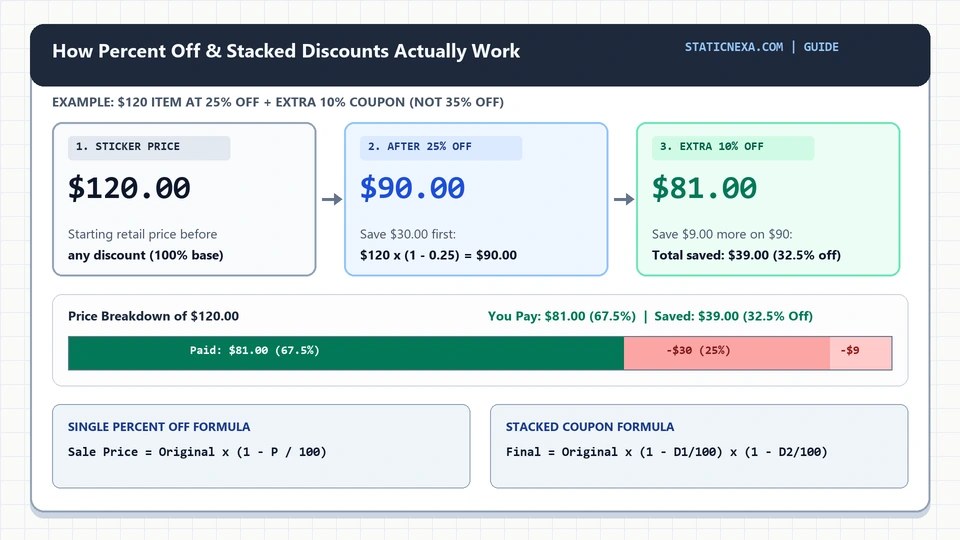
Example 2: Stacked Coupon (25% Off + Extra 10% Off on a $120 Jacket)
Suppose a $120.00 winter jacket is on sale for 25% off, and you apply an extra 10% off promo code at checkout. Many shoppers add 25% + 10% and expect 35% off ($78.00), then feel surprised at checkout. Here is the exact math stores use:
- Apply the first 25% discount to $120:
$120 × (1 − 0.25) = $90.00(you save$30.00). - Apply the extra 10% coupon to the new $90.00 subtotal:
$90 × (1 − 0.10) = $81.00(you save an extra$9.00). - Total savings:
$30.00 + $9.00 = $39.00, which equals($39 ÷ $120) × 100 = 32.5%total off.
0.75 × 0.90 = 0.675, meaning you pay 67.5% of the sticker price and save 32.5%.
Quick Percent Off Reference Table
Use this quick cheat sheet to estimate common retail discounts at a glance:
| Percent Off | Multiplier Paid | Final on $50 | Final on $100 | Savings on $100 |
|---|---|---|---|---|
| 10% off | × 0.90 | $45.00 | $90.00 | $10.00 |
| 15% off | × 0.85 | $42.50 | $85.00 | $15.00 |
| 20% off | × 0.80 | $40.00 | $80.00 | $20.00 |
| 25% off | × 0.75 | $37.50 | $75.00 | $25.00 |
| 30% off | × 0.70 | $35.00 | $70.00 | $30.00 |
| 40% off | × 0.60 | $30.00 | $60.00 | $40.00 |
| 50% off | × 0.50 | $25.00 | $50.00 | $50.00 |
| 75% off | × 0.25 | $12.50 | $25.00 | $75.00 |
Excel & Google Sheets Formulas
Managing store pricing or a shopping budget in a spreadsheet? Drop these formulas straight into Excel or Google Sheets (with discount rates formatted as percentages like 25% or decimals like 0.25):
Sale Price (Stacked): =Original * (1 - Discount1) * (1 - Discount2)
Find Percent Off: =(Original - SalePrice) / ABS(Original)
For details on how we handle rounding and edge cases across all Staticnexa tools, see our Editorial & Mathematical Accuracy Policy.
Frequently Asked Questions
How do you calculate percent off a price quickly?
Subtract the discount percent from 100% to find the percentage you pay, turn it into a decimal, and multiply by the original price. For 30% off $80, multiply $80 by 0.70 to get $56.
How much is 25% off $120 plus an extra 10% off?
First take 25% off $120 to get $90, then take 10% off $90 to get a final price of $81. Your total savings are $39, which is 32.5% off (not 35% off).
Does sales tax apply before or after a percent off discount?
In most retail purchases, store discounts and coupons reduce the item price first, and sales tax is calculated on the discounted sale price (except in specific manufacturer rebate rules depending on local tax law).
How do I find what percent off a sale price is?
Subtract the sale price from the original price, divide by the original price, and multiply by 100. For example, if an $80 item sells for $56, you save $24, and (24 / 80) x 100 = 30% off.
How do I find the original price before a percentage off discount?
Divide the sale price by (1 - Discount% / 100). If an item costs $56 after 30% off, divide $56 by 0.70 to recover the original $80 sticker price.
Mathematical References & Standards
- OpenStax Prealgebra (2e): Section 6.3: Solve Sales Tax, Commission, and Discount Applications (Open textbook reference for retail discount rates and sale price equations)
- Khan Academy: Percentage Change Review & Discount Word Problems (Practice examples for percent-off calculations and multipliers)
- Wikipedia: Discounts and Allowances: Chain & Trade Discounts (Formal explanation of stacked chain discounts in retail and commerce)
- U.S. Federal Trade Commission (FTC): Consumer Advice: Shopping, Coupons & Pricing Transparency (Official consumer guidance on retail pricing, deals, and comparison shopping)