What Are Significant Figures?
Significant figures (commonly shortened to sig figs or significant digits) are the digits in a measured or calculated number that carry real information about its precision. Unlike pure mathematical integers such as 12 eggs or 2π, every physical measurement read from a ruler, analytical balance, thermometer, or digital voltmeter contains limited resolution plus one last estimated digit.
Writing extra calculator digits such as reporting 4.56 × 1.4 = 6.384 implies thousandths-place accuracy that your 1.4 sensor never measured. Using proper significant figure rules prevents false precision across chemistry labs, engineering tolerances, and scientific reports. Our calculator classifies every digit in your number individually, converts ambiguous integers into unambiguous Scientific Notation and Engineering Notation, and evaluates multi-operator expressions using full guard digits before rounding once at the end.
The 5 Rules for Counting Significant Figures
Every counting decision comes down to one simple question: which digits are reliable measurements, and which zeros act purely as decimal-place spacers? Apply these five universal conventions:
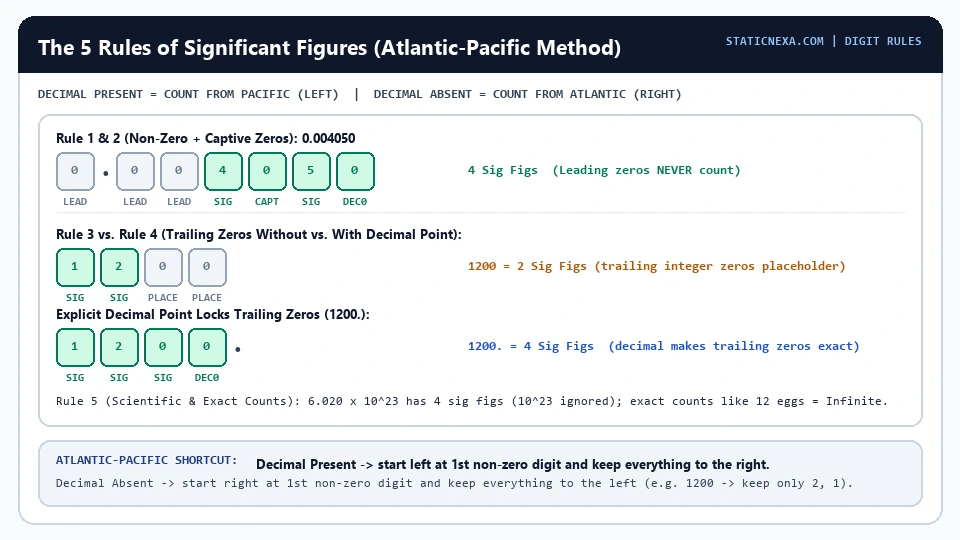
- All Non-Zero Digits (1 through 9) Are Always Significant: Every digit from
1to9contributes to precision. For example,4,218contains4significant figures. - Captive (Sandwiched) Zeros Are Always Significant: Any zero located strictly between two non-zero digits carries measured value. In
1005or4.05, the interior zeros are significant (4and3sig figs). - Leading Zeros to the Left Never Count: Zeros before the first non-zero digit serve only to position the decimal point. In
0.004050, the three zeros in0.00are pure placeholders (changing units to millimeters yields4.050), leaving 4 significant figures (4, 0, 5, 0). - Trailing Zeros Count ONLY When a Decimal Point Is Present: In
0.004050and12.30, the final zero lies to the right of a decimal point and explicitly signals measured accuracy (4sig figs each). In an integer without a decimal point such as1200, trailing zeros are treated by convention as non-significant placeholders (2sig figs), whereas writing an explicit decimal point (1200.) locks all4digits as significant. - Exact Constants & Discrete Counts Have Infinite Precision: Defined unit conversions (
1 inch = 2.54 cm,1 kg = 1000 g) and whole counted objects (15beakers) never limit significant figures in an arithmetic problem.
The Atlantic-Pacific Shortcut
Need to count digits in two seconds during an exam? Picture a map of North America with the Pacific Ocean on the left and the Atlantic Ocean on the right:
- Decimal Point Present = Start from Pacific (Left): Move rightward until hitting the first non-zero digit (skipping
0.00), then count that digit and every digit remaining to the right (0.004050 -> 4, 0, 5, 0 = 4 sig figs). - Decimal Point Absent = Start from Atlantic (Right): Move leftward until hitting the first non-zero digit (skipping trailing integer zeros), then count that digit and every digit remaining to the left (
1200 -> 2, 1 = 2 sig figs).
Significant Figures Rules for Math Operations (+, −, ×, ÷)
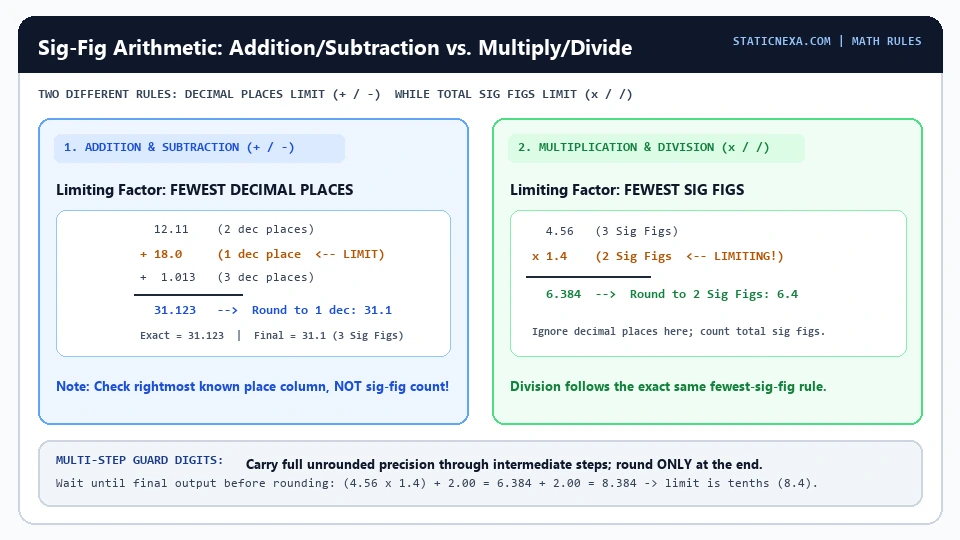
One of the biggest traps in physics and chemistry homework is applying the same sig-fig rule to every operator. In reality, addition/subtraction and multiplication/division obey completely different precision constraints:
Multiplication & Division (×, ÷): Round result to the FEWEST TOTAL SIGNIFICANT FIGURES
Chained Multi-Step Expressions: Keep all unrounded guard digits internally; round ONLY the final result
| Operation Type | Limiting Precision Rule | Quick Example | Exact vs. Final Result |
|---|---|---|---|
Addition (+) |
Fewest decimal places / rightmost shared column | 12.11 + 18.0 + 1.013 | 31.123 -> 31.1 (1 dec place) |
Subtraction (−) |
Fewest decimal places (can shrink total sig figs!) | 12.34 − 12.31 | 0.03 -> 0.03 (drops to 1 sig fig) |
Multiplication (×) |
Fewest total significant figures | 4.56 × 1.4 | 6.384 -> 6.4 (2 sig figs) |
Division (÷) |
Fewest total significant figures | 12.50 ÷ 2.5 | 5.0 -> 5.0 (retain trailing .0!) |
2 Worked Examples
Example 1: Mixed Multi-Step Arithmetic Using Guard Digits ((4.56 × 1.4) + 2.00)
Evaluate (4.56 × 1.4) + 2.00 cleanly following OpenStax Chemistry 2e chained rounding rules, rather than rounding prematurely after the multiplication:
- Compute the inner product with guard digits:
4.56 × 1.4 = 6.384. Under the multiplication rule,4.56has3sig figs and1.4has2sig figs, so if stopped here the product would track2sig figs, meaning its last certain position is the tenths place (6.4,10⁻¹). - Keep full unrounded
6.384for the addition: Add2.00(known to hundredths,10⁻²):6.384 + 2.00 = 8.384. - Determine final limiting column: Between the product's tenths uncertainty (
10⁻¹) and2.00's hundredths uncertainty (10⁻²), tenths (10⁻¹) is less precise and wins the bottleneck. - Round once at the end: Rounding
8.384to the tenths place gives 8.4 (2sig figs). Notice that rounding prematurely to6.4 + 2.00happens to give8.4here, whereas in expressions like(4.53 × 1.4) + 2.04premature rounding (6.3 + 2.04 = 8.34 -> 8.3) drifts away from true guarded rounding (6.342 + 2.04 = 8.382 -> 8.4)!
Example 2: Counting, Rounding & Eliminating Ambiguous Zeros (1204 and 0.004050)
Compare rounding a small decimal (0.004050 to 2 sig figs) against rounding a four-digit integer (1204 to 3 sig figs):
- Case A (Small Decimal
0.004050 -> 2sig figs): Leading zeros0.00do not count toward the2sig figs. Starting at4, keep the first two significant digits (4, 0) and inspect the 3rd digit (5). Under standard Half-Up rounding,5rounds0up to1, producing 0.0041 (or4.1 × 10^-3in scientific notation). - Case B (Integer Trap
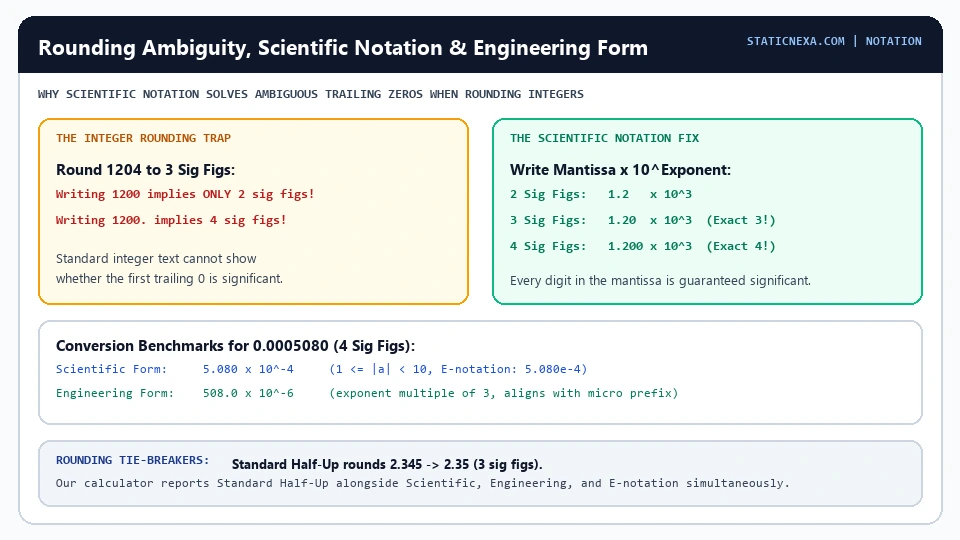
1204 -> 3sig figs): Starting at1, keeping three digits gives1, 2, 0with trailing digit4dropped (1200). However, plain text1200looks like2sig figs, while adding a decimal point (1200.) forces4sig figs! Writing1.20 × 10^3in normalized scientific notation displays exactly three significant figures without any ambiguity.
Scientific Notation vs. Engineering Notation
When working across electronics, physics, or chemistry, Mode 3 (Scientific & Engineering Form) generates two complementary exponential formats simultaneously:
- Normalized Scientific Notation (
a × 10^b, where1 ≤ |a| < 10): Ensures one non-zero integer digit before the decimal point. Every digit insideais significant. For instance,0.0005080becomes5.080 × 10^-4(preserving all 4 sig figs cleanly). - Engineering Notation (
a × 10^(3k), where exponent is divisible by 3): Matches standard SI metric prefixes directly:10^3(kilo),10^6(mega),10^-3(milli),10^-6(micro), and10^-9(nano). Thus0.0005080 metersconverts immediately to508.0 × 10^-6 m(508.0 µm, micrometers) without losing its trailing significant zero.
What About Logarithms & Antilogarithms (pH Chemistry Rule)?
Students studying acid-base chemistry often wonder why pH values carry extra decimal digits. When taking a base-10 logarithm (pH = −log₁₀[H⁺]), the integer part before the decimal point (the characteristic) encodes only the power-of-10 exponent, while only digits after the decimal point (the mantissa) reflect significant figures:
Example ([H⁺] = 2.5 × 10^-4 M, 2 sig figs): pH = −log₁₀(2.5 × 10^-4) = 3.60 (2 decimal places!)
Reversing the calculation ([H⁺] = 10^-3.60) gives 2.5 × 10^-4 (2 sig figs matching the 2 decimal places of 3.60).
Half-Up Rounding vs. Banker's Rounding (Half-to-Even)
What should happen when the first dropped digit is an exact midpoint 5 with nothing non-zero after it, such as rounding 2.345 or 2.355 to 3 significant figures? Schools and our calculator apply Standard Half-Up rounding, which always bumps an exact 5 upward (2.345 -> 2.35 and 2.355 -> 2.36).
In contrast, NIST metrology handbooks and ASTM laboratory standards sometimes specify Round-Half-to-Even (often called Banker's Rounding): when the dropped tail is exactly .5, round toward whichever neighboring digit is even (2.345 -> 2.34 because 4 is even, while 2.355 -> 2.36 because 6 is even). Across thousands of experimental averages, rounding ties evenly prevents small systematic upward drift.
5 Common Significant Figure Mistakes to Avoid
- Treating Leading Zeros Like
0.00as Significant: Leading zeros only shift the decimal point and never measure accuracy. Only start counting at the first non-zero digit. - Dropping Trailing Decimal Zeros After Division (
12.50 ÷ 2.5 = 5): A calculator screen prints5, hiding uncertainty. Because both inputs justify2sig figs, you must write5.0! - Rounding Too Early Inside Multi-Step Equations: Rounding every intermediate bracket introduces drift. Carry extra guard digits until the final answer, as Mode 2 (Sig-Fig Arithmetic) automatically demonstrates.
- Using Total Sig Figs Instead of Decimal Places on Addition: In
100.5 + 2.13, the limiting term is100.5(1 decimal place, NOT fewest sig figs), giving102.6. - Rounding Unit Conversion Factors Like
1000 m / 1 km: Defined metric multipliers and exact integers (like dividing 4 trials by4to take a mean) have infinite significant figures and never restrict your final precision.
Related Math & Chemistry Precision Tools
Explore complementary error, percentage, and statistical calculators inside our Math & Statistics hub:
- Percent Error Calculator: evaluate experimental measurement accuracy against accepted reference values.
- Standard Deviation Calculator & Mean Calculator: report measurement repeatability across replicate trials.
- Decimal to Percent Calculator & Fraction to Percent Calculator: convert measured ratios cleanly.
Read how Staticnexa tests rounding boundaries and expression precision rules in our Editorial & Mathematical Accuracy Policy.
Frequently Asked Questions
Do leading zeros count as significant figures?
No. Leading zeros to the left of the first non-zero digit (such as 0.00 in 0.004050) are strictly placeholders that mark decimal scale. They are never counted as significant figures.
When do trailing zeros count as significant figures?
Trailing zeros always count when a decimal point is present anywhere in the number (e.g., 12.30, 0.050, or 1200. all treat trailing zeros as significant). In plain integers without a decimal point like 1200, trailing zeros are non-significant placeholders.
What is the difference between addition and multiplication sig-fig rules?
For addition and subtraction, round the final answer to match the input with the fewest decimal places (largest uncertain place column). For multiplication and division, round to match the input with the fewest total significant figures.
How do you write 1200 with 3 significant figures?
Use normalized scientific notation: 1.20 x 10^3 (or 1.20e3). Plain integer text 1200 implies 2 sig figs and 1200. implies 4 sig figs, so scientific notation removes all ambiguity.
What does a trailing decimal point like "1200." mean?
Adding an explicit decimal point at the end of a whole number (1200.) indicates that all zeros before the decimal point were actually measured, giving 4 significant figures instead of 2.
Why should you keep guard digits during multi-step calculations?
Rounding intermediate steps introduces cumulative rounding error. Standard laboratory and engineering practice keeps all unrounded digits throughout intermediate steps, tracks the limiting uncertainty rule at each step, and rounds once at the final result.
Mathematical References & Standards
- OpenStax Chemistry (2e): Section 1.5: Measurement Uncertainty, Accuracy, and Precision (Textbook rules for non-zero digits, captive/trailing zeros, and chained guard-digit rounding)
- Chemistry LibreTexts: Section 1.5: Uncertainty in Measurement (Brown et al.) (Comparison of decimal-place addition/subtraction rules versus significant-figure multiplication/division rules)
- NIST Reference on Constants, Units, and Uncertainty: Rules and Style Conventions for Expressing Values of Quantities (Federal metrology conventions on numerical rounding, exact constants, and scientific formatting)
- Khan Academy: Significant Figures Rules Review (Visual exercises on leading zeros, trailing decimal zeros, and scientific notation)
- Wikipedia: Significant Figures: Conventions, Ambiguity & Arithmetic Rules (Detailed overview of integer zero ambiguity, base-10 logarithm rule, and rounding methods)